On this page
The Hellespont and the final campaign
By 405 BCE the Peloponnesian War had continued for more than two decades. Athens had survived the disaster in Sicily and rebuilt fleets, but its position depended heavily on maritime communications and supplies. The Hellespont, the strait now called the Dardanelles, connected the Aegean with the routes toward the Black Sea. Operations there could threaten the grain traffic on which Athens relied, making the region strategically important beyond any one naval encounter.
Lysander exercised effective command of the Spartan fleet even though Aracus held the formal naval office. The arrangement accommodated the prohibition on a second term as navarch. Persian support, particularly Lysander's relationship with Cyrus the Younger, helped sustain the ships and their crews. This was a war of finance, provisioning, and diplomacy as much as tactical skill. Spartan success at sea rested on resources and labor drawn from well beyond the citizen community in Laconia.[1][2][3]
Opposing shores and daily routines
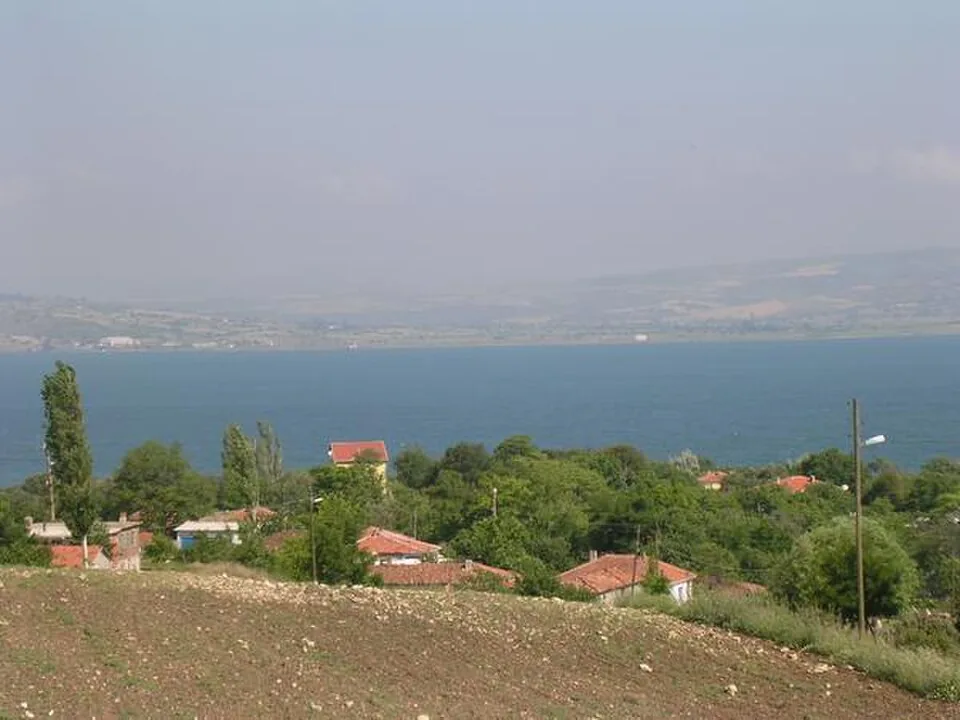
Lysander operated from Lampsacus on the Asian side of the strait after capturing the city. The Athenian fleet took a position opposite, near Aegospotami on the European shore. Xenophon describes the Athenians repeatedly sailing out to offer battle while Lysander kept his forces ready and observed their behavior. Their exposed anchorage and the need for crews to disperse in search of supplies became central features of his explanation of the defeat.
The exact ancient location associated with Aegospotami is not equivalent to a securely surveyed battlefield. The name refers to a coastal setting, and the encyclopedia's marker represents the gazetteer location rather than a precise point where ships were seized. Distances and provisioning routes matter to the reconstruction, but surviving narratives do not identify every landing place. A map can clarify the relationship across the strait without pretending to settle all the topographical questions.[1][3]
Surprise and disagreement among sources
In Xenophon's version, Lysander waited until the Athenians had returned to shore and their crews dispersed, then attacked after receiving a signal from scouts. Most of the ships were captured with little opportunity for organized resistance. Other ancient traditions differ over movements immediately before the attack, including whether an Athenian force had already sailed out. These differences affect the tactical reconstruction and should not be concealed beneath one confident modern diagram.
Conon escaped with a small number of ships, and the Paralus carried news to Athens. Lysander also took many prisoners. Ancient accounts describe the execution of captured Athenians and connect the decision with accusations about earlier Athenian conduct toward enemies. The details belong to a brutal wartime context and to narratives interested in explaining retribution. They should be presented as reported decisions and arguments, rather than as proof that violence was either uniquely Spartan or morally inevitable.[1][2]
From a lost fleet to a besieged city
With most of its fleet gone, Athens could no longer protect its communications effectively. Lysander moved through the remaining Athenian sphere of influence and then toward the city, while Spartan land forces added pressure. Xenophon describes the arrival of the news at Athens as a moment of fear for both immediate survival and retaliation. The final surrender came in 404 BCE after blockade and hunger, not at the instant the ships were captured.
Aegospotami is often treated as the decisive battle of the war because it removed the military instrument that had sustained Athenian resistance. That judgment should still leave room for the accumulated effects of years of losses, allied revolts, Persian funding, and political decisions. The victory also created new problems for Sparta, whose authority across the Aegean proved difficult to stabilize. Its significance lies in both outcomes: the destruction of Athenian naval power and the beginning of a contested Spartan predominance.[1][2]
FOLLOW THE EVIDENCE
References & further reading
- Ancient textXenophon, Hellenica ↗
H. G. Dakyns translation, public domain. Covers the later Peloponnesian War and Greek affairs down to 362 BCE.
- Ancient textPlutarch, Life of Lysander ↗
Bernadotte Perrin translation, public domain. A later moral biography preserving traditions about naval command, patronage, and Spartan power.
- Modern scholarshipLivius: Aigospotamoi, the campaign of 405 BCE ↗
Historical reconstruction discussing the sources and the arrangement of Lysander's second command.