On this page
An economy behind an ideal
Sparta's reputation for plain living has often been expanded into the claim that its inhabitants had little use for trade or money. The ancient evidence is more complicated. Authors praised restrictions on citizen profit-seeking and luxury, but the state still needed goods, resources, and external relationships. A distinction is necessary between ideals concerning the conduct of full citizens and the economic activity of the larger population under Spartan authority.
Perioikic communities participated in agriculture, production, and exchange, and coastal settlements connected the region to maritime routes. Imported objects and the distribution of Laconian products reveal contacts beyond the citizen center. They do not tell us every detail of commercial organization, but they make complete isolation implausible. The practical requirements of equipment, food supply, craft materials, and diplomacy linked Sparta to a wider Greek economy.[2][3]
The story of iron money
Plutarch attributes to Lycurgus the suppression of gold and silver currency and the introduction of bulky iron money. In the narrative, the iron was treated so that it would be unsuitable for ordinary productive use, and its inconvenience discouraged accumulation and foreign commerce. The account offers a vivid moral lesson: a lawgiver can restrain greed by making wealth difficult to store and move.
The historical character of this story is disputed. Questions include whether particular iron objects functioned as exchange media, how early practices related to later narratives, and whether prohibitions applied to individuals, the state, or specific forms of possession. The existence of iron in an economic setting does not validate every detail of Plutarch's explanation. Nor does uncertainty about the story establish that Spartan authorities never restricted precious metal. Different propositions require different evidence.
The story also gives the lawgiver control over the relationship between material objects and desire. That moral purpose helps explain why later readers remembered the iron currency even when actual economic practice was more complicated.[1][4]
Goods, craftsmanship, and connections
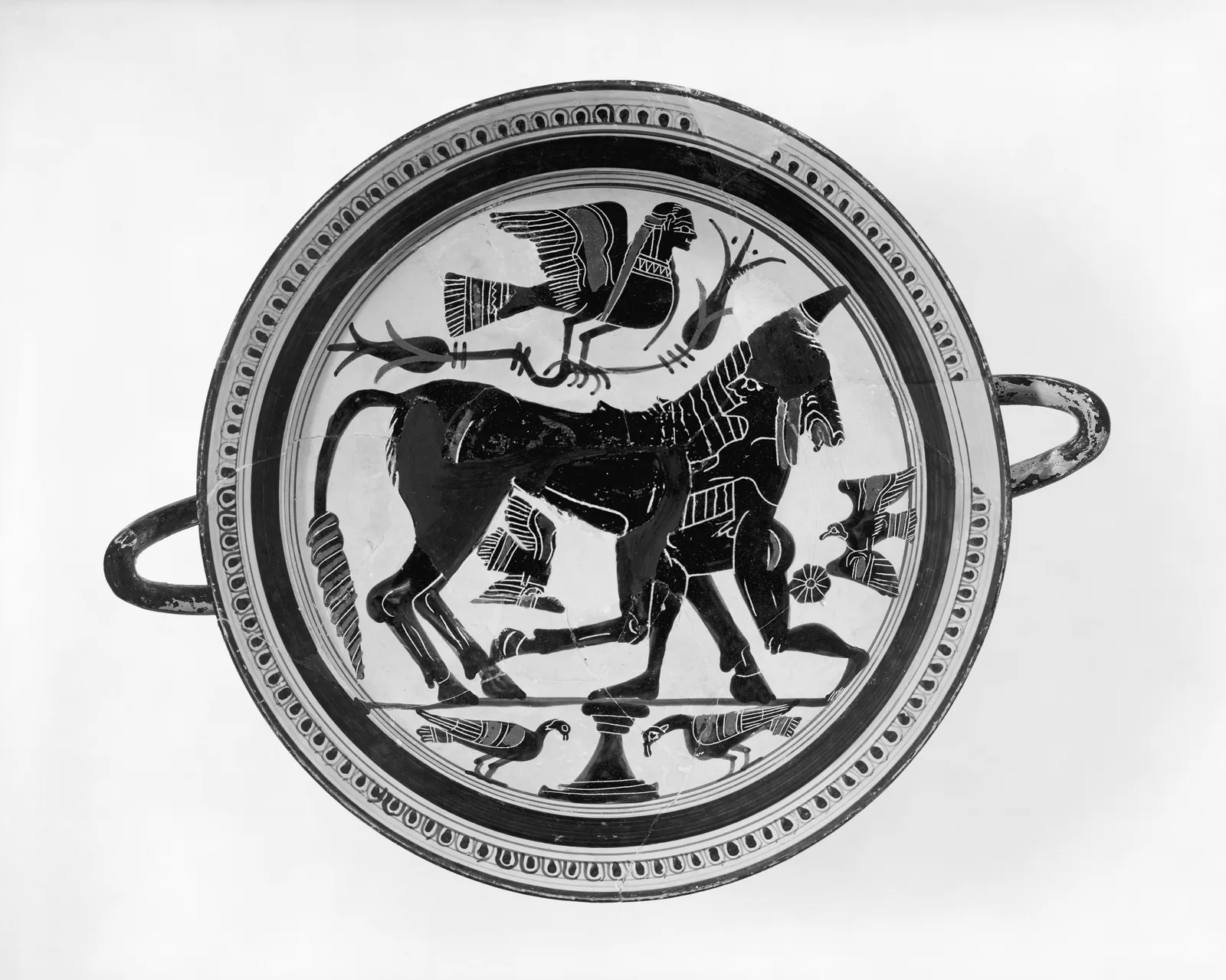
Laconian painted pottery circulated outside the region during the Archaic period. Fine vessels, metalwork, and other crafted objects reveal skills and networks incompatible with an image of universal indifference to material culture. Some objects moved through trade, while others may have traveled as gifts, dedications, or possessions. Archaeological distribution establishes movement more securely than it identifies the social status or intentions of every person involved.
Production and exchange should also be distinguished from a citizen's public reputation. A community could praise restraint while containing wealthy households and supporting skilled craftsmanship. Restrictions might target visible display or particular occupations without abolishing every economic interest. The tension between ideals and practice is not an embarrassment to be explained away; it is part of the history. Rules reveal what authorities wished to encourage or discourage, while objects and transactions reveal a wider range of activity.[3][2]
War, wealth, and changing pressures
The prolonged struggle with Athens and the expansion of Spartan influence brought new financial demands and opportunities. Naval warfare required funding, and Persian support became crucial in the final phase of the Peloponnesian War. Commanders operating abroad could gain resources and networks that complicated domestic ideals of modesty. Xenophon's criticism of contemporary ambition acknowledges that Spartan behavior could depart from the principles he admired.
Later coinage and Hellenistic political changes belong to still different economic circumstances. It is therefore misleading to speak of a single Spartan monetary system lasting unchanged through antiquity. The more useful question is how authorities and households negotiated the relationship between public ideals and material needs at particular times. Trade and currency show Sparta as a participant in a connected world, even when some of its most influential stories represented separation from that world as a source of virtue.[2][4]
FOLLOW THE EVIDENCE
References & further reading
- Ancient textPlutarch, Life of Lycurgus ↗
Bernadotte Perrin translation, public domain. Written centuries after Classical Sparta; anecdotes and institutional origins are not independently verified by their inclusion.
- Ancient textXenophon, Constitution of the Lacedaemonians ↗
H. G. Dakyns translation, public domain. An admiring fourth-century BCE account of Spartan institutions.
- ArchaeologyThe Metropolitan Museum of Art: Art and Craft in Archaic Sparta ↗
Museum essay on Laconian pottery, metalwork, carving, and sculpture, with collection examples.
- Modern scholarshipSparta: Beyond the Mirage — Iron Money in Sparta: Myth and History ↗
Scholarly volume containing a study of iron money as a monetary and historical problem; table of contents and publisher material.