On this page
The material world beyond austerity
Sparta's reputation for restraint can make its art seem surprising. The surprise arises partly from treating literary ideals about citizens' conduct as a complete description of everything made and used in Laconia. Archaeological objects and ancient descriptions show a different picture. Pottery, metalwork, carving, and sacred monuments formed part of the region's history. Their production required skill, resources, and relationships extending beyond the battlefield.
The label Laconian identifies a regional artistic tradition, not automatically the legal status of an individual maker. Craftspeople could belong to different communities, and objects rarely supply the social information historians would like to recover. It is therefore unsafe to assign every workshop confidently to full citizens or to perioikoi. The broader point is secure: the state centered on Sparta existed within a productive landscape capable of sophisticated visual expression.[2][1]
A cup and its painted world
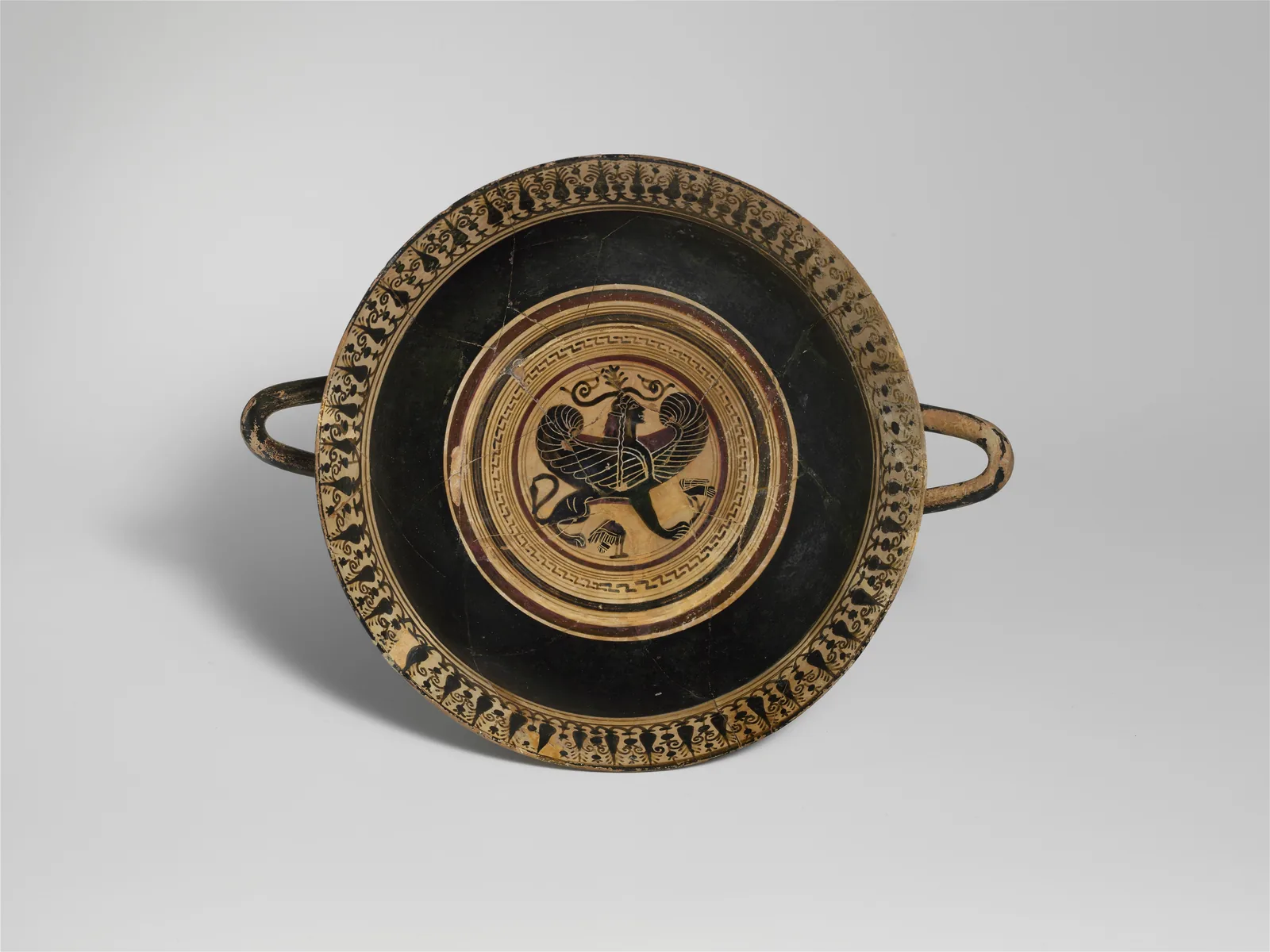
The drinking cup featured in this encyclopedia belongs to The Metropolitan Museum of Art and is attributed to the Boreads Painter, around 570–560 BCE. Its decorated interior depicts the apotheosis of Herakles. The attribution is a modern scholarly grouping based on style rather than the recovery of the painter's personal name. Such names help organize relationships among objects while preserving the distinction between identified works and an anonymous historical craftsperson.
A drinking vessel combines practical use with imagery. Its decoration would be encountered through handling, looking, and the social setting of consumption. It should not be treated simply as a flat illustration detached from its shape. Nor can one fine cup establish the habits of every Spartan household. Its significance is more precise: it provides a tangible example of regional craftsmanship and participation in a shared Greek mythological vocabulary.[3]
Small offerings and large monuments
Laconian sanctuaries received small votive objects, including cast lead figures. The Met's example of a warrior with helmet and shield belongs to this tradition. Such objects connected the resources of worshippers with acts of dedication. Their repeated production can reveal common forms and expectations, even when individual dedicators remain anonymous. A modest object may therefore contribute to social and religious history as much as a celebrated monumental work.
At the other end of the scale, Pausanias describes elaborate sacred art associated with Athena Chalkioikos and Apollo at Amyclae. He attributes the former's artistic work to Gitiadas and the latter's throne to Bathycles of Magnesia. These descriptions connect local patronage with mythological narrative and, in Bathycles' case, a craftsman associated with another region. The surviving words cannot recover every lost form, but they make clear that public sacred display could be ambitious.
A sanctuary could accumulate many small gifts across generations, so repeated forms matter alongside unique masterpieces.[4][1]
Production, circulation, and interpretation
Objects moved through exchange, gifts, travel, and dedication. A Laconian vessel found elsewhere in the Mediterranean demonstrates circulation, but it may not identify the route or the person responsible. The distribution of finds must also be interpreted in light of excavation and survival. Archaeological visibility is uneven, and absence from one context is not proof of an absolute prohibition. Artistic change likewise cannot always be explained by one political reform.
Studying craftsmanship helps replace an overly uniform Sparta with a society containing different settings of use and value. An ideal of modest citizen behavior could coexist with decorated vessels, religious gifts, and richly narrated monuments. The contradiction becomes less severe when the evidence is separated by date, context, and social group. Art matters here not as a decorative exception to the real Spartan story, but as evidence for the skills, beliefs, contacts, and choices through which inhabitants shaped the material world around them.[2][1][3]
FOLLOW THE EVIDENCE
References & further reading
- Ancient textPausanias, Description of Greece, Book 3 ↗
The second-century CE travel account of Laconia. Its monuments and local traditions belong to the author's time and require comparison with earlier evidence.
- ArchaeologyThe Metropolitan Museum of Art: Art and Craft in Archaic Sparta ↗
Museum essay on Laconian pottery, metalwork, carving, and sculpture, with collection examples.
- ArchaeologyThe Met: Laconian drinking cup, 50.11.7 ↗
Terracotta kylix attributed to the Boreads Painter, c. 570–560 BCE. Collection record, image, and object context.
- ArchaeologyThe Met: Lead figure of a warrior with a helmet and shield ↗
Collection record for a Laconian votive figure, with context on dedications at regional sanctuaries.