On this page
Athena at the civic heights
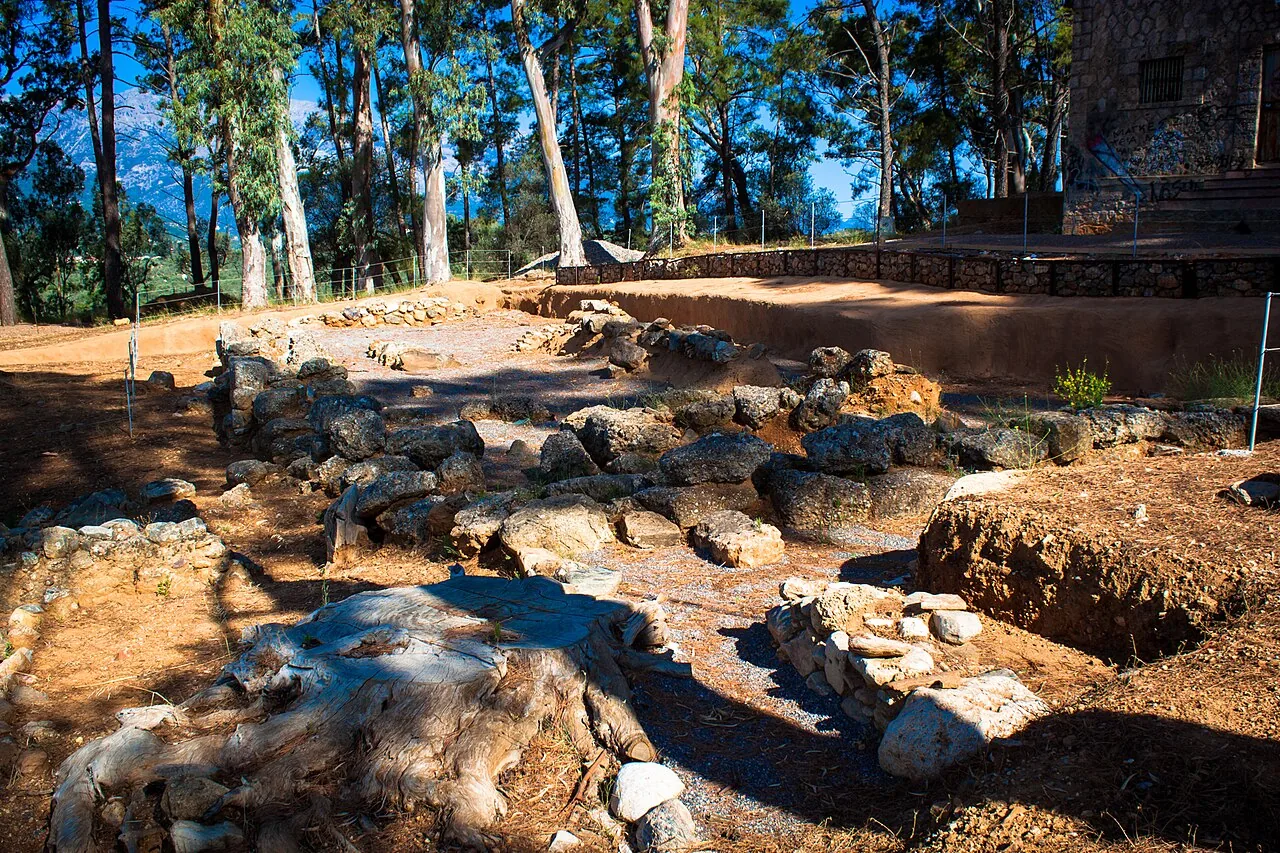
Athena Chalkioikos, commonly translated as Athena of the Bronze House, had a sanctuary on the Spartan acropolis. The goddess was associated with protection of the city, and Pausanias also identifies her with the title Polias. Her cult demonstrates that Spartan religion included civic guardianship and monumental artistic expression, not simply rites performed before campaigns. The sanctuary occupied a place of political as well as sacred importance within the community.
The acropolis at Sparta should not be imagined as an exact counterpart of the monumental Athenian Acropolis. Local topography and building history differed. Nevertheless, a less dramatic surviving architectural landscape does not imply that its sacred places were insignificant. Sanctuaries organized memory, public display, and relations with the gods. Their authority could affect the actions of officials and the interpretation of political events.[1]
Bronze, image, and craftsmanship
Pausanias attributes the sanctuary's artistic work and the image of Athena to Gitiadas, a local craftsman. He also credits him with songs, including a hymn to the goddess. The association of artistic and musical accomplishment is valuable evidence against a narrowly military picture of Spartan public culture. The same sacred setting could bring together visual narrative, skilled production, and performance.
The epithet Bronze House is usually connected with bronze decoration of the sanctuary. Pausanias describes mythological scenes represented in the metalwork, including stories familiar across the Greek world. The building's artistic program situated the local goddess within a broader network of heroic and divine narratives. Although much of the original material is lost, the description shows why the sanctuary cannot be dismissed as merely a plain shelter for a utilitarian cult. Its appearance and stories were part of how it mattered.
Pausanias' account names Gitiadas as both an artist and a poet.[1][3]
Pausanias the regent and sanctuary
The sanctuary is especially prominent in the story of Pausanias, the Spartan regent who commanded the Greek army at Plataea. After accusations concerning his dealings with Persia and other alleged misconduct, he took refuge in a sacred setting associated with Athena. Thucydides reports that the authorities confined him there and brought him out near death so that he would not die within the sanctuary.
The episode raises questions about the protection owed to a suppliant and the religious consequences of political punishment. Removing a dying man did not necessarily erase the pollution associated with how he had been treated. Ancient tradition connected the event with subsequent obligations imposed on Sparta. The details vary in later retellings, and Pausanias the traveler adds stories of his own. The regent and the much later travel writer are different people, an important distinction when following these accounts.[2][1]
FOLLOW THE EVIDENCE
References & further reading
- Ancient textPausanias, Description of Greece, Book 3 ↗
The second-century CE travel account of Laconia. Its monuments and local traditions belong to the author's time and require comparison with earlier evidence.
- Ancient textThucydides, History of the Peloponnesian War ↗
Richard Crawley translation, public domain. A contemporary source for the late fifth-century BCE conflict, with retrospective accounts of earlier events.
- ArchaeologyThe Metropolitan Museum of Art: Art and Craft in Archaic Sparta ↗
Museum essay on Laconian pottery, metalwork, carving, and sculpture, with collection examples.