On this page
A city and a wider state
Sparta was a Greek city in the Eurotas valley of the southern Peloponnese. Its name can refer to the settlement itself, the community of full citizens, or a state that governed much of Laconia and, for centuries, Messenia. These meanings overlap, but they are not interchangeable. Many people who supported Spartan power lived outside the citizen community. Understanding their different circumstances is essential to understanding the city.
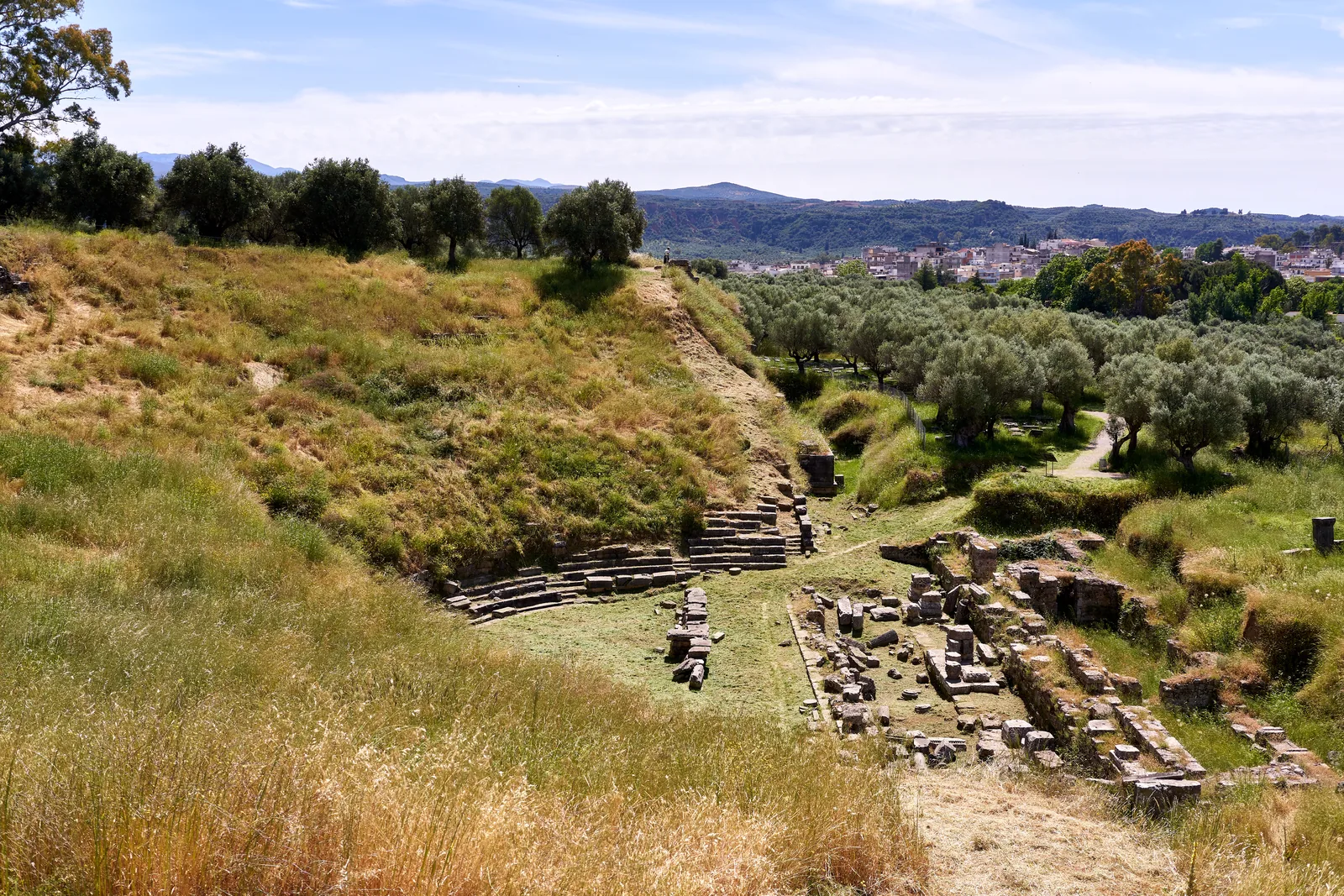
The physical settlement was less monumental than the great image of its power might suggest. In a famous comparison, Thucydides imagined future visitors judging Sparta by its surviving buildings and underestimating its strength. His point concerned the danger of equating political influence with urban grandeur. It does not mean that Sparta lacked sanctuaries, public spaces, artistic production, or a history of construction. Archaeology reveals an inhabited landscape whose character changed over many centuries.[1][3]
The people behind the name
Full male citizens, commonly called Spartiates, formed a privileged group expected to participate in military service and communal institutions. Their households depended substantially on agricultural labor performed by helots, an unfree population subjected to extraction and coercion. The helots of Laconia and Messenia did not necessarily share identical histories. Treating them simply as a background labor force hides their families, resistance, and importance to the state.
Perioikoi lived in communities around the citizen center. They were free but excluded from the central citizen assembly, and they contributed troops and economic activity. Women belonging to citizen households could possess property and occupy prominent religious roles, yet these advantages did not extend equally to every woman under Spartan rule. An account of Spartan society must therefore distinguish social position as well as gender. The disciplined citizen body was only one part of a much larger population.[2][1]
Institutions, worship, and daily life
Two royal houses supplied Sparta with hereditary kings. Kings operated alongside ephors, a council of elders, and an assembly of citizens. Their authority was consequential but neither unlimited nor uniform across every period. Shared meals, education, athletic competition, and expectations of obedience helped reproduce citizen identity. Xenophon admired this organization and explained it through laws attributed to Lycurgus. His admiration makes him valuable evidence for Spartan ideals, while also requiring readers to distinguish an ideal from ordinary practice.
Religion was integral to political and social life. Sanctuaries helped connect neighborhoods, countryside, and civic institutions. Offerings at Artemis Orthia reveal devotion through objects rather than through the prescriptions of elite writers. Laconian pottery, bronzes, and carved objects also complicate the familiar image of a community indifferent to beauty. Poetry, festivals, and performance belonged to Spartan history alongside campaigning and collective discipline.[2][3]
Power, defeat, and reinvention
Sparta became a leading power through conquest, alliances, and its reputation in land warfare. Its place in resistance to the Persian invasions and its eventual victory over Athens brought it enormous influence. That influence depended on other communities and could be contested by allies as well as enemies. The defeat at Leuctra and the subsequent independence of Messenia severely weakened the resources and assumptions supporting Spartan predominance.
The city nevertheless continued to exist. Hellenistic reformers contested property and citizenship, and Roman-era inhabitants maintained or reinvented institutions associated with their famous past. The visible ruins belong to several periods and should not all be assigned to the age of Leonidas. Modern visitors and readers encounter both an ancient community and the stories repeatedly told about it. Reading those stories against institutions, material remains, and the experiences of subordinated people produces a fuller history than either admiration or condemnation alone.
The independence of Messenia after 369 BCE altered both the state's territory and the resources available to its citizens. This is a particularly clear reason to distinguish Classical hegemony from the city's later history.[4][3]
FOLLOW THE EVIDENCE
References & further reading
- Ancient textThucydides, History of the Peloponnesian War ↗
Book 1.10 on Sparta's urban appearance; Books 1 and 4 on power, alliances, and helot revolt. Richard Crawley translation, public domain.
- Ancient textXenophon, Constitution of the Lacedaemonians ↗
Especially chapters 1–10 and 15. Read the admiring account of institutions alongside its own acknowledgment of change.
- ArchaeologyBritish School at Athens: Sparta excavations ↗
Archaeological context for sanctuaries, settlement remains, and the varied periods represented in the ancient city.
- Ancient textXenophon, Hellenica ↗
H. G. Dakyns translation, public domain. Covers the later Peloponnesian War and Greek affairs down to 362 BCE.