On this page
An annual office with broad reach
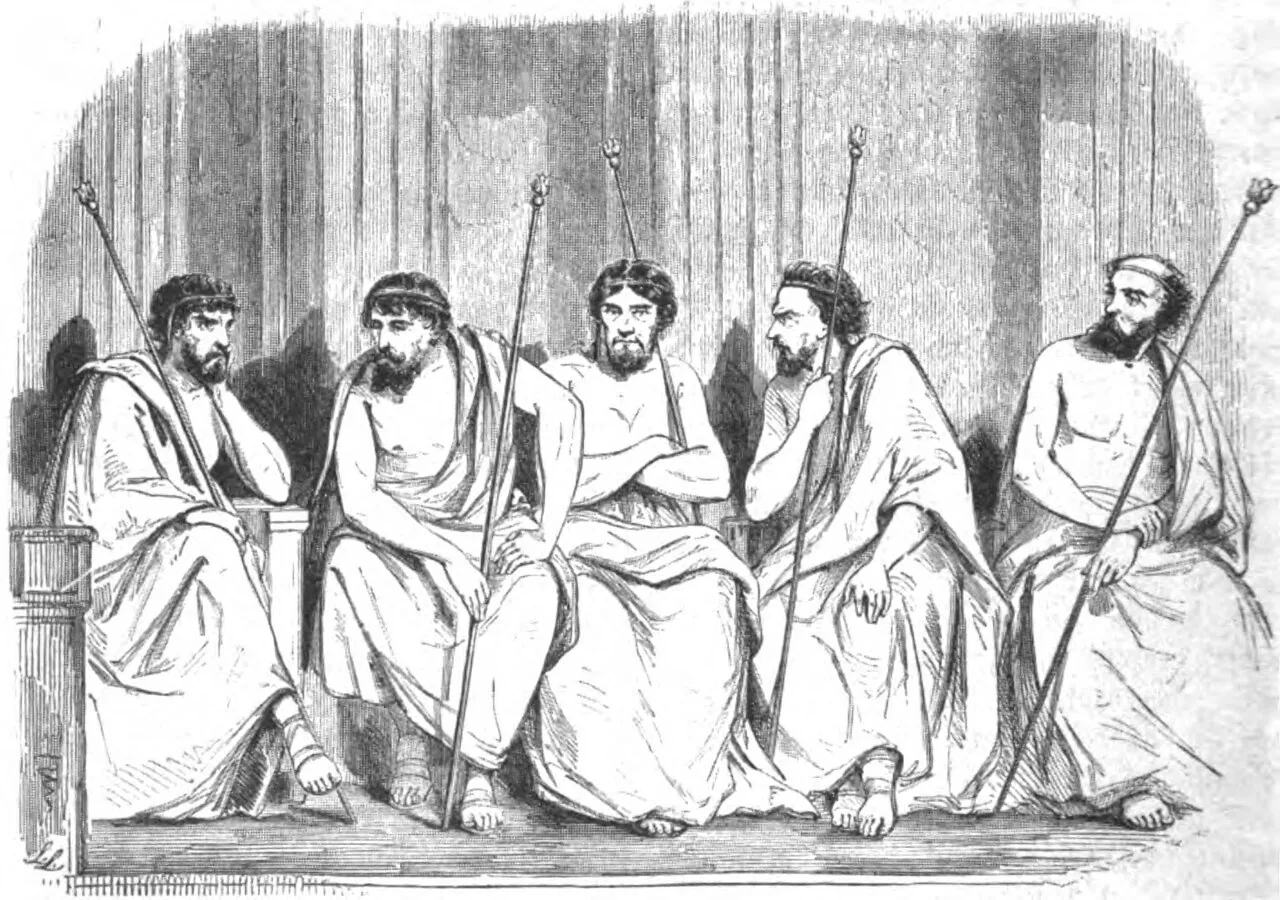
The ephors were a board of five magistrates chosen annually from the Spartan citizen body. Their name is commonly understood as overseers. Unlike kings, they did not inherit office, and unlike elders, they did not hold it for life. The annual change could bring shifts in policy and political alignment. Although the office was open within the citizen group more broadly than the royal houses or council, it was not an institution representing all inhabitants under Spartan rule.
Ancient accounts disagree about its origins and relationship to the laws of Lycurgus. Some traditions associate its establishment with a later stage of constitutional development. Those disagreements are a warning against imagining a complete Spartan system created in one founding act. By the Classical period, however, the ephors were central participants in public life. Their authority mattered because it connected oversight of daily conduct with decisions affecting the state as a whole.
Their annual replacement distinguished them from hereditary kings and elders who normally held office for life.[1][2]
Kings and civic supervision
Xenophon describes a monthly exchange of oaths between kings and ephors. The king promised to rule according to the laws, while the ephors undertook to preserve kingship if that condition was met. The formulation made royal authority part of a reciprocal constitutional relationship. A hereditary position with sacred prestige could therefore coexist with officials empowered to supervise and challenge its holder.
Ephors could be involved in proceedings against kings and in monitoring military leadership. Their influence helped ensure that decisions made on campaign remained connected to the civic community. This did not mean that every king was politically weak or that the ephors acted as a perfectly united counterweight. Personal alliances, reputation, and disagreement within the board could affect outcomes. Institutional powers created possibilities, but particular people still had to decide how to use them.[1][2]
Deliberation and public decisions
The ephors participated in the handling of assembly business, diplomatic contacts, and the implementation of public decisions. Thucydides' account of the debate before the Peloponnesian War gives a vivid example in the ephor Sthenelaidas. His intervention helped frame the choice presented to the citizens, and the manner of voting became part of the political action. The episode shows that procedure and persuasion were closely connected.
The exact division of responsibility between ephors, elders, and assembly remains debated. It is unsafe to assign one modern governmental branch to each Spartan institution and assume a neat separation of functions. The same official might exercise administrative, judicial, and deliberative influence. Nor did annual tenure automatically prevent strong power: a short term could still give its holders decisive leverage at a moment of war, succession, or internal conflict.[3][4]
Criticism and later change
Aristotle regarded the ephorate as powerful and criticized the possibility that poorly resourced officeholders might be susceptible to bribery. That argument reveals his assumptions about wealth and political judgment as well as his concerns about corruption. It should not be read as proof that every ephor was corrupt. More broadly, he saw the office as a means through which the citizen population could support and identify with the constitution.
The ephorate's later history demonstrates that an institution presented as ancestral could become a target of radical change. Cleomenes III attacked the office during his reform program, showing that claims to restore Sparta's past could accompany the removal of one of its familiar authorities. The ephors matter because they make visible the active politics within a society often represented as uniformly obedient. Oversight, rivalry, legal constraint, and the practical conduct of government were as much part of Spartan history as the commands of kings.[2][4][1]
FOLLOW THE EVIDENCE
References & further reading
- Ancient textXenophon, Constitution of the Lacedaemonians ↗
H. G. Dakyns translation, public domain. An admiring fourth-century BCE account of Spartan institutions.
- Ancient textAristotle, Politics, Book 2.9 ↗
Benjamin Jowett translation, public domain. Aristotle evaluates the Spartan constitution critically, including property, women, offices, and common meals.
- Ancient textThucydides, History of the Peloponnesian War ↗
Richard Crawley translation, public domain. A contemporary source for the late fifth-century BCE conflict, with retrospective accounts of earlier events.
- Modern scholarshipDivided Power and Eunomia: Deliberative Procedures in Ancient Sparta ↗
Scholarly analysis of how the council, ephors, and assembly interacted; interpretation of their powers remains debated.