On this page
A founder beyond a secure chronology
Lycurgus occupies a central place in Spartan tradition but cannot be given a reliable lifetime. Ancient writers disagreed about his ancestry, dates, travels, and legislation. Plutarch begins his biography by acknowledging these disagreements, rather than supplying a contemporary record. The familiar portrait of one man designing Spartan society therefore belongs first to the history of how Spartans explained their institutions. It cannot establish that those institutions appeared together in a single founding moment.
Some traditions placed him near the earliest kings; others associated him with the beginnings of the Olympic festival. Attempts to reconcile these chronologies could even produce more than one Lycurgus. His reported position as guardian of the young king Charilaus provided a particularly useful narrative: he could exercise authority while refusing to seize the throne. Whether an individual lawgiver stands behind these traditions remains unresolved. A precise birth date would conceal that uncertainty.
Even his position in the royal genealogy varies between accounts.[1]
The constitution attributed to him
Ancient authors connected Lycurgus with the council of elders, arrangements for the assembly, communal meals, and the education of boys. The Great Rhetra, preserved by Plutarch in a form presented as an oracle, helped give this constitution divine sanction. Delphi mattered because an institution approved by Apollo could claim an authority greater than a temporary political majority. Yet the relation between that text and actual changes in early Sparta remains debated.
Xenophon treats Lycurgus as an unusually insightful legislator who understood how to turn private conduct toward civic purposes. His account links marriage, upbringing, dining, and military discipline through deliberate rules. This is a powerful interpretation of Sparta, but its coherence is also the author's achievement. Customs observed or praised in the fourth century BCE do not automatically date to a remote founder. Institutions could develop gradually and later acquire the same ancestral name.[2][1]
Property, reform, and retrospective ideals
Plutarch credits Lycurgus with an equal division of land and measures against luxury, including a cumbersome iron currency. These episodes are especially difficult to treat as straightforward economic history. Classical Sparta contained substantial inequalities of property, and Aristotle criticized the concentration of land and the exclusion of men unable to contribute to common meals. A society described as preserving Lycurgus' laws could nevertheless display conditions far removed from the equal allotments of the foundation story.
Later reformers could turn that gap into a political argument: their proposals restored ancestral equality rather than invented a new order. This made Lycurgus relevant to the disputes of Agis IV and Cleomenes III in the third century BCE. Modern research on landholding and inheritance asks whether the supposed original system ever existed in the form later authors imagined. The problem is not solved simply by assuming that every inequality resulted from a subsequent corruption.[1][3][4]
A life made into a moral example
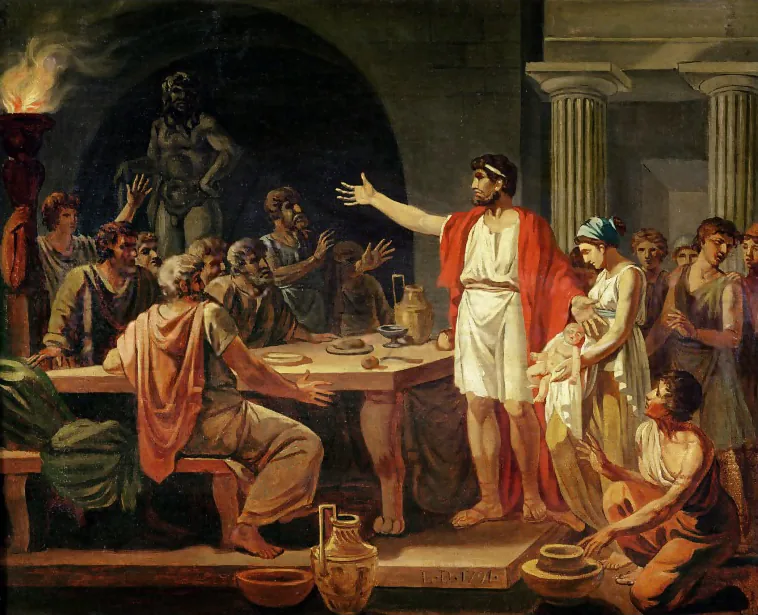
Stories about Lycurgus describe journeys to Crete and other lands, resistance to his reforms, personal restraint, and a final departure after making the Spartans promise to preserve his laws until his return. His death abroad then supposedly kept the oath binding. Such episodes explain the permanence of a constitution through the self-denial of its founder. They are memorable political storytelling, but their literary usefulness is not independent evidence that they happened.
Lycurgus should consequently be read on two levels. A historical inquiry asks which institutions can be documented and how their forms changed. An inquiry into memory asks why Spartans and outsiders needed an authoritative founder to connect those institutions. Both are valuable. Dismissing the traditions as useless misses their influence; accepting every episode as biography turns a long and contested social history into the work of one exemplary man.[1][2]
FOLLOW THE EVIDENCE
References & further reading
- Ancient textPlutarch, Life of Lycurgus ↗
Bernadotte Perrin translation, public domain. Written centuries after Classical Sparta; anecdotes and institutional origins are not independently verified by their inclusion.
- Ancient textXenophon, Constitution of the Lacedaemonians ↗
H. G. Dakyns translation, public domain. An admiring fourth-century BCE account of Spartan institutions.
- Ancient textAristotle, Politics, Book 2.9 ↗
Benjamin Jowett translation, public domain. Aristotle evaluates the Spartan constitution critically, including property, women, offices, and common meals.
- Modern scholarshipStephen Hodkinson, Land Tenure and Inheritance in Classical Sparta ↗
Scholarly reassessment of property and inheritance; the publisher abstract highlights the significance of women's property rights.