On this page
A city seen through expectations
The expression Spartan mirage refers to idealized or otherwise distorting images that can stand between readers and the historical community. Sparta has been portrayed as uniquely disciplined, perfectly equal, permanently militarized, or almost untouched by change. Each image may draw on something ancient, but the combination can produce a society that never existed in the form imagined. The problem began long before modern films or popular history.
Ancient writers often used Sparta to think about their own communities. Its institutions could serve as a model, a criticism of luxury, an example of obedience, or a warning about a constitution's defects. Their works remain indispensable. The task is not to discard them because they had purposes, but to identify those purposes and consider what they made the authors emphasize, simplify, or leave out.[1][2][3]
Admiration and the lawgiver
Xenophon organizes his account around the distinctive laws attributed to Lycurgus. He admires their capacity to produce disciplined citizens, and he repeatedly contrasts Spartan practice with that of other Greeks. This arrangement is analytically useful, but it can make difference appear more absolute than everyday experience warrants. His acknowledgment that Spartans did not always follow ancestral principles is also significant. Even an admirer recognized a gap between prescription and conduct.
Plutarch's Life of Lycurgus offers a memorable system of reforms, customs, and sayings. Yet the biography begins with uncertainty about its subject and was written centuries after the Classical period. Its episodes often teach moral lessons. A vivid anecdote may therefore survive because it was effective as an example, not because a contemporary witness documented it. The lawgiver's authority also made later changes appear as a recovery of ancient order.[1][2]
Selective modern inheritances
Later readers have drawn different lessons from this material. Some have celebrated civic commitment or resistance to luxury; others have focused on coercion, exclusion, or militarism. The same supposed Spartan characteristic can be praised in one setting and condemned in another. A modern reference to Sparta consequently tells us something about the person using it as well as about the ancient evidence behind it.
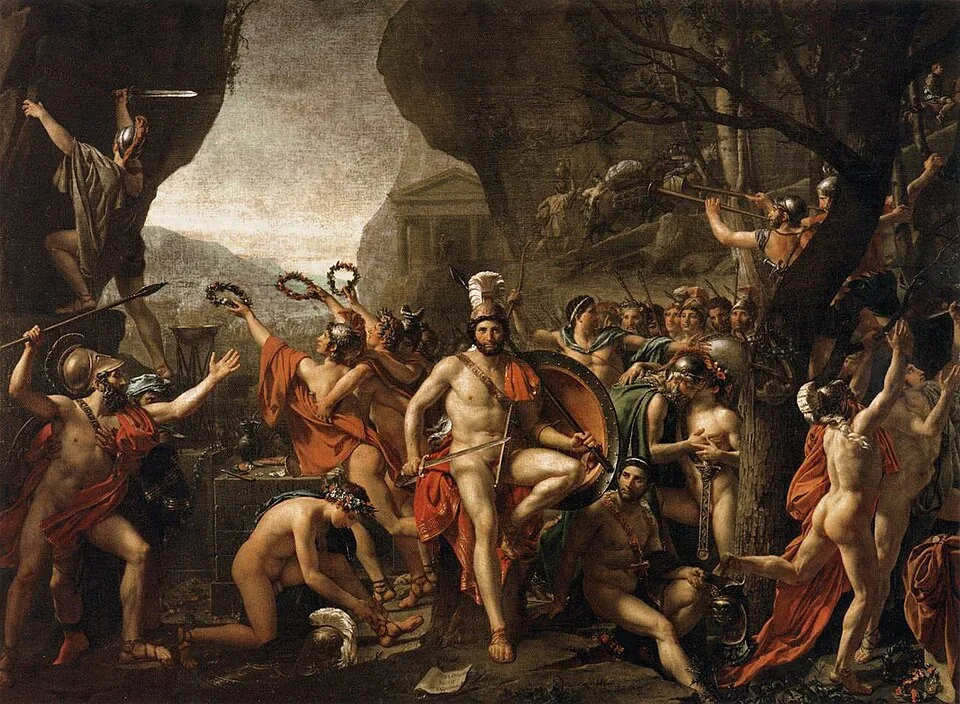
Popular depictions often narrow the story to warriors, Thermopylae, and spectacular bodily discipline. This emphasis can make helot labor, agricultural dependence, craft production, diplomacy, and religious performance disappear. It can also generalize the relative privileges of women in citizen families into an account of all women under Spartan rule. Restoring these distinctions does not require replacing every positive image with its negative opposite. It requires asking whose experience a claim actually describes and in which period it applies.[3][1][2]
A practical way to read Sparta
Begin with the date and genre of a source. A contemporary military narrative, a philosophical criticism, a late biography, and an excavated dedication provide different kinds of evidence. Next ask whether the passage describes a rule, an ideal, a remembered event, or observed practice. Finally, compare it with other testimony where possible. Contradictions can reveal change or disagreement rather than merely an error that must be removed.
The term mirage should not become a shortcut for declaring all ancient testimony false. Skepticism is valuable when it is specific: a doubtful quotation, an uncertain chronology, or a later custom projected backward. It becomes less useful when it turns into an equally sweeping counter-image. The aim of this encyclopedia is to preserve complexity without making the subject inaccessible. Sparta was a historical community of unequal inhabitants, powerful institutions, cultural achievements, violence, and adaptation. Its long afterlife is part of that history, but it should not be allowed to replace the people who lived it.
Xenophon's own acknowledgment that behavior had changed is a useful place to begin that comparison.[1][2][3]
FOLLOW THE EVIDENCE
References & further reading
- Ancient textXenophon, Constitution of the Lacedaemonians ↗
H. G. Dakyns translation, public domain. An admiring fourth-century BCE account of Spartan institutions.
- Ancient textPlutarch, Life of Lycurgus ↗
Bernadotte Perrin translation, public domain. Written centuries after Classical Sparta; anecdotes and institutional origins are not independently verified by their inclusion.
- Modern scholarshipSparta in Modern Thought: Politics, History and Culture ↗
Publisher preview of the volume edited by Stephen Hodkinson and Ian Macgregor Morris; introduction to the changing reception of Sparta.