On this page
Which women are being described?
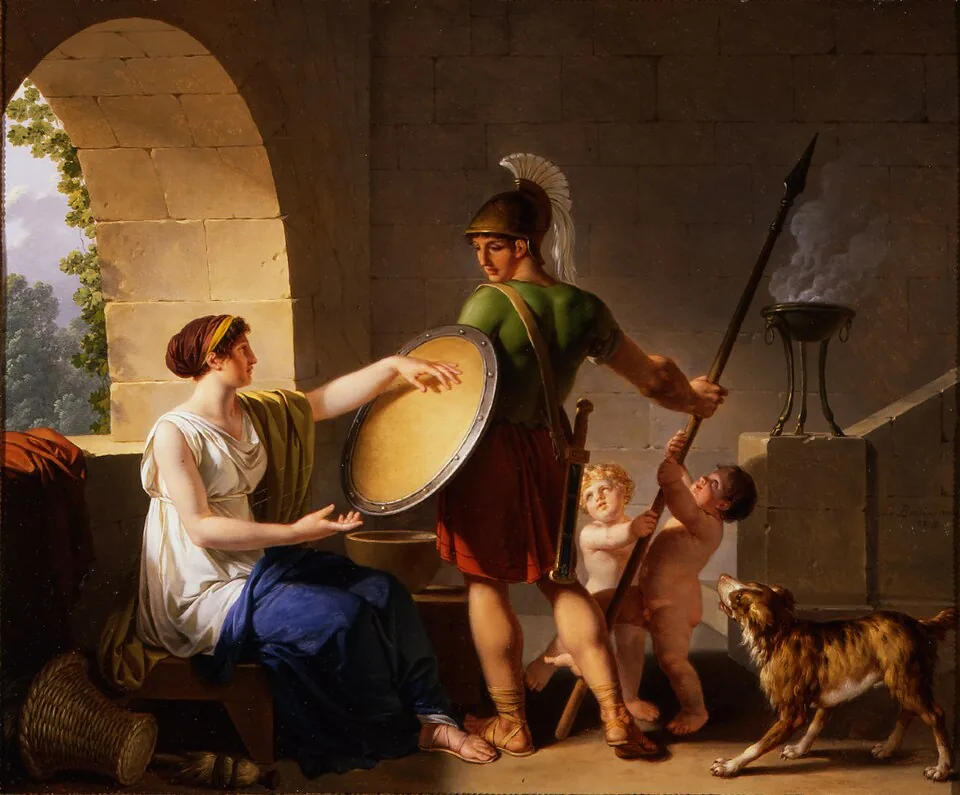
Ancient discussions of Spartan women usually focus on females belonging to citizen households. These women could hold property, take part in religious life, and receive physical training that outsiders found striking. Such features have encouraged the description of Sparta as unusually favorable to women. The comparison requires qualification. Citizen women did not share men's central political rights, and their circumstances cannot stand for the experience of helot women or women in perioikic communities.
Social position shaped access to resources, protection, and public recognition. A woman in a wealthy citizen family could exercise influence through land, marriage connections, or religious standing. An enslaved woman faced coercion and labor demands with far fewer safeguards. Treating both as members of one undifferentiated category of Spartan women turns the privileges of a minority into a misleading account of the whole society.[1][2]
Education and physical activity
Xenophon describes exercise for girls and explains it through the production of strong offspring. Plutarch also associates female physical activity with the legislation of Lycurgus. These accounts show that ancient observers connected girls' upbringing with the future of the citizen community. They do not establish that girls followed the same program as boys, or that every detail in a late description belonged unchanged to the Classical period.
Choral performance and religious observance supplied other settings in which girls and women could participate visibly. Education should therefore not be reduced to running and wrestling. Songs, ritual knowledge, social relationships, and household responsibilities also mattered. Much of this activity is poorly documented compared with the upbringing of citizen boys. The imbalance of surviving evidence is a reason for caution, rather than a reason to assume that women's lives consisted only of the few practices male authors found unusual.[1][3]
Property and household power
Aristotle criticized the amount of property held by Spartan women and linked it to his broader assessment of the constitution. His account is evidence for the significance of female property ownership, but it is also an argument shaped by his assumptions about gender and proper political order. The numerical proportions he supplies should not be treated as a modern statistical survey. Historians examine inheritance, gifts, marriage, and household strategies to understand how holdings were transmitted.
Property could provide practical authority without formal equality in political institutions. Citizen women might have substantial interests in decisions about land and heirs, especially when men were absent on campaign. Yet the stereotype of women simply running everything at home can be as reductive as the idea of complete female seclusion. Households included people with different legal statuses and conflicting interests. Their management rested on unequal labor as well as on the influence of their most privileged members.[2][4]
Named women and the limits of anecdote
Gorgo and Cynisca are among the best-known Spartan women. Gorgo appears in stories emphasizing intelligence and sound judgment; Cynisca achieved Olympic victory as the owner of a winning chariot team. Their prominence reveals possibilities available to women connected with royal households. It does not provide a representative sample of ordinary life. Fame, wealth, and family position helped make them visible to authors and commemorators.
Collections of sayings also depict Spartan mothers urging sons to uphold civic courage. These stories can illuminate ideals of motherhood and sacrifice, but individual quotations are often difficult to verify. They should be introduced as attributed sayings rather than transcripts. A responsible account holds several facts together: some citizen women possessed resources and visibility unusual by certain Greek comparisons; political rights remained unequal; and other women under Spartan rule experienced exploitation that the celebrated anecdotes largely ignore. That combination gives a more useful picture than either unqualified admiration or a claim that every Greek community treated women identically.[3][2][1]
FOLLOW THE EVIDENCE
References & further reading
- Ancient textXenophon, Constitution of the Lacedaemonians ↗
H. G. Dakyns translation, public domain. An admiring fourth-century BCE account of Spartan institutions.
- Ancient textAristotle, Politics, Book 2.9 ↗
Benjamin Jowett translation, public domain. Aristotle evaluates the Spartan constitution critically, including property, women, offices, and common meals.
- Ancient textPlutarch, Life of Lycurgus ↗
Bernadotte Perrin translation, public domain. Written centuries after Classical Sparta; anecdotes and institutional origins are not independently verified by their inclusion.
- Modern scholarshipStephen Hodkinson, Land Tenure and Inheritance in Classical Sparta ↗
Scholarly reassessment of property and inheritance; the publisher abstract highlights the significance of women's property rights.