On this page
Unfreedom at the center of the system
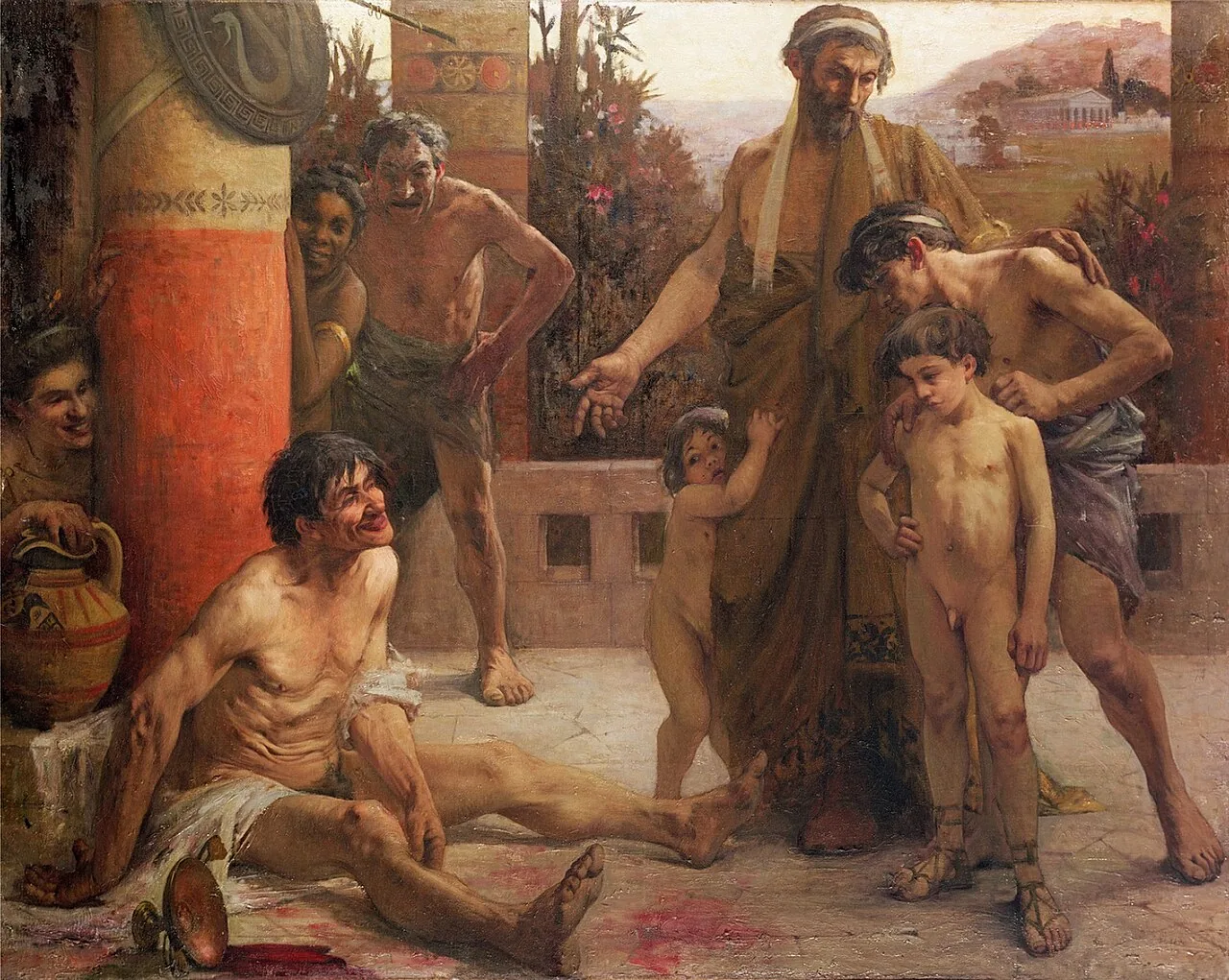
Helots were an unfree population subjected to Spartan control. Their agricultural labor was fundamental to the resources of citizen households and to the institutions those households maintained. The exact legal character of helotage remains debated: historians ask how authority was divided between individual holders and the wider state, and how tenure, transfer, and obligations worked. These uncertainties do not make their condition voluntary. Coercion and exclusion were basic features of the relationship.
The helots of Laconia and Messenia should not be treated as a population with one securely known origin. Ancient explanations connect subjection with conquest, but the processes may have varied by region and period. Later Messenian traditions emphasized a history of collective resistance and recovered freedom. That identity was politically consequential, even where historians disagree about its continuity from the earliest stages of Spartan expansion.[1][2]
Households, fields, and extraction
Helots worked land and delivered produce that supported the privileged citizen community. Farming demanded planning, knowledge, and repeated seasonal labor. The existence of helot families and some scope for managing everyday cultivation should not be confused with freedom from domination. People can sustain households, skills, and communal attachments while remaining vulnerable to extraction and violence. The practical capacity to organize work is different from the legal and political capacity to refuse an imposed obligation.
Literary sources are much more interested in the consequences of helotage for Spartans than in the daily experience of the laborers themselves. Women and children are especially difficult to recover. Their contribution to agricultural and domestic work must not disappear merely because elite male authors left few individual names. When citizen women are described as having unusual independence, the labor and limited protection of women in enslaved households form an essential part of the same social history.[3][1]
Fear, violence, and resistance
Spartan concern about revolt appears repeatedly in the sources. Thucydides reports the disappearance of a large group of helots selected after being invited to identify themselves as deserving freedom. He describes the event as a secret killing, although the precise circumstances cannot be independently reconstructed. Plutarch's account of the krypteia adds a later tradition of selected young Spartans killing helots in the countryside. The two reports should not automatically be merged into one continuously documented institution.
The revolt after the earthquake of the 460s BCE demonstrated that domination could be challenged collectively. Rebels held out at Ithome, and the conflict affected Sparta's relations with Athens and other allies. Enslaved people were therefore not merely a passive resource. Their actions and the possibility of resistance shaped military decisions, diplomacy, and the deployment of citizen manpower. A history that treats helots only as a percentage of the population misses this political agency.[1][2]
Service, emancipation, and liberation
Sparta sometimes used helots in military service and offered emancipation as a reward or recruitment incentive. Those who fought with Brasidas in the northern Aegean provide an important example. Freed groups did not necessarily enter the full citizen body. Freedom, residence, military obligation, and political membership were separate questions, and the evidence contains several status terms whose exact relationships are not always clear. Exceptional advancement should not be mistaken for a generally open path into the citizen elite.
The independence of Messenia after 371 BCE removed a major population and territory from Spartan domination. It did not end every form of unfreedom throughout Laconia. Later rulers made further changes under different political circumstances. Helot history consequently has no single simple ending. Its significance is clear, however: the celebrated leisure, solidarity, and military commitment of Spartan citizens depended on people denied equivalent rights. Their work, families, endurance, and resistance belong at the center of the explanation of Sparta.[1][3]
FOLLOW THE EVIDENCE
References & further reading
- Ancient textThucydides, History of the Peloponnesian War ↗
Richard Crawley translation, public domain. A contemporary source for the late fifth-century BCE conflict, with retrospective accounts of earlier events.
- Ancient textPlutarch, Life of Lycurgus ↗
Bernadotte Perrin translation, public domain. Written centuries after Classical Sparta; anecdotes and institutional origins are not independently verified by their inclusion.
- Ancient textAristotle, Politics, Book 2.9 ↗
Benjamin Jowett translation, public domain. Aristotle evaluates the Spartan constitution critically, including property, women, offices, and common meals.