On this page
A royal woman in the record
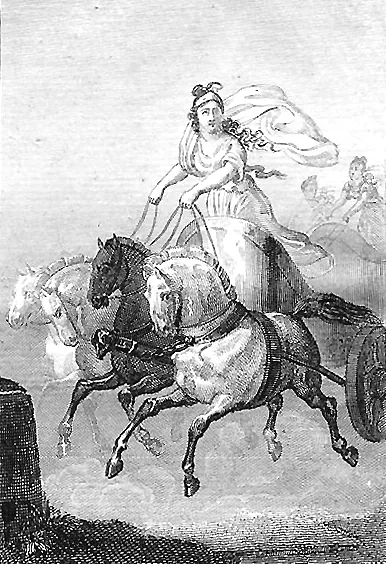
Cynisca was a daughter of the Eurypontid king Archidamus II and a sister of Agesilaus II. Her family placed her among the wealthiest and most prominent people in Sparta. She is remembered as the first woman to win at the Olympic Games, through victories by her four-horse chariot teams in 396 and 392 BCE. The formulation requires explanation because equestrian victories followed different rules from contests in which an athlete competed with their own body.
The owner of a winning team received the victory, even when someone else drove the chariot. Cynisca's achievement therefore does not mean that she personally raced around the Olympic course. Nor does it establish that women generally enjoyed the same access to Olympic competition as men. Her participation used a particular opening within the organization of equestrian events. Understanding that opening makes her accomplishment more historically precise without diminishing its public significance.[1][2]
Horses, property, and the work of others
Maintaining a competitive four-horse team required resources: land or access to fodder, suitable animals, experienced handlers, and a trained driver. The victory belonged publicly to the owner, but it depended on the labor of many people whose names were less likely to be recorded. Cynisca's case thus connects sport with household wealth and the wider economy. It also reminds us that ancient athletic honor could reward ownership and organization as well as physical performance.
Spartan citizen women could possess substantial property, and a royal woman's access to resources was especially significant. Yet the surviving evidence does not give a complete account of Cynisca's estate or establish exactly how each part of her racing operation was managed. It would be misleading to turn her success into proof that all Spartan women were independently wealthy. Enslaved women and men sustained the society in which elite families could pursue costly prestige projects.[2][3]
A monument and competing explanations
Pausanias saw a monument to Cynisca at Olympia that included a chariot, horses, a driver, and her own image. He also mentions inscriptions connected with her victory. The arrangement gave the female owner a visible place in a sanctuary crowded with the achievements of men and ruling families. The commemorative claim mattered beyond the instant of the race: it made her distinction available to later visitors who had never witnessed the competition.
Plutarch reports that Agesilaus encouraged his sister to enter, intending to demonstrate that equestrian victories depended on wealth rather than personal excellence. This explanation places the achievement inside a moral portrait of the king. It need not exhaust Cynisca's motives, which are not directly preserved. A brother could interpret a victory as a lesson about money while the woman commemorated it as an unprecedented honor. Ancient accounts can preserve overlapping agendas rather than one uncontested meaning.[1][3]
What her exceptional visibility shows
Cynisca became a precedent for other women who won as equestrian owners. Her example belongs to a wider history of female participation in sport that varied across places, festivals, and kinds of competition. A research collection such as the Mannheim Cynisca project helps bring these scattered testimonies together. It also encourages a distinction between women as competitors, owners, dedicators, and participants in religious festivals, roles too easily combined under a single modern category.
Her story is especially useful because it joins material commemoration to literary testimony. The monument described at Olympia, the royal genealogy, and the accounts of Agesilaus do different kinds of evidentiary work. Together they support a clear historical achievement while leaving much of the person unknown. We should neither reduce Cynisca to her brother's supposed experiment nor invent a modern campaign for equal rights on her behalf. Her victories show an elite woman claiming distinction within the opportunities and inequalities of her society.[4][1][2]
FOLLOW THE EVIDENCE
References & further reading
- Ancient textPausanias, Description of Greece 6.1–18 ↗
W. H. S. Jones translation, public domain. Descriptions of athletic monuments at Olympia, including Cynisca's dedication.
- Ancient textPausanias, Description of Greece, Book 3.1–13 ↗
Royal traditions and the description of Sparta. A Roman-era account, not a contemporary record of the Archaic period.
- Ancient textPlutarch, Life of Agesilaus ↗
Bernadotte Perrin translation, public domain. Compare this later biography with Xenophon's contemporary but admiring account.
- Modern scholarshipCynisca: Documenting Women and Girls in Ancient Greek Sports ↗
University of Mannheim research resource collecting evidence for female participation in ancient Greek sport.