On this page
A land and sea defense
Thermopylae lay on a route into central Greece where mountains approached the coast. In 480 BCE Greek defenders hoped to use its narrowness against the much larger army brought by Xerxes. The position was coordinated with naval resistance at Artemisium, since a fleet could threaten a land force's flank or communications. It was one element of a coalition strategy, not an isolated encounter planned without reference to the sea.
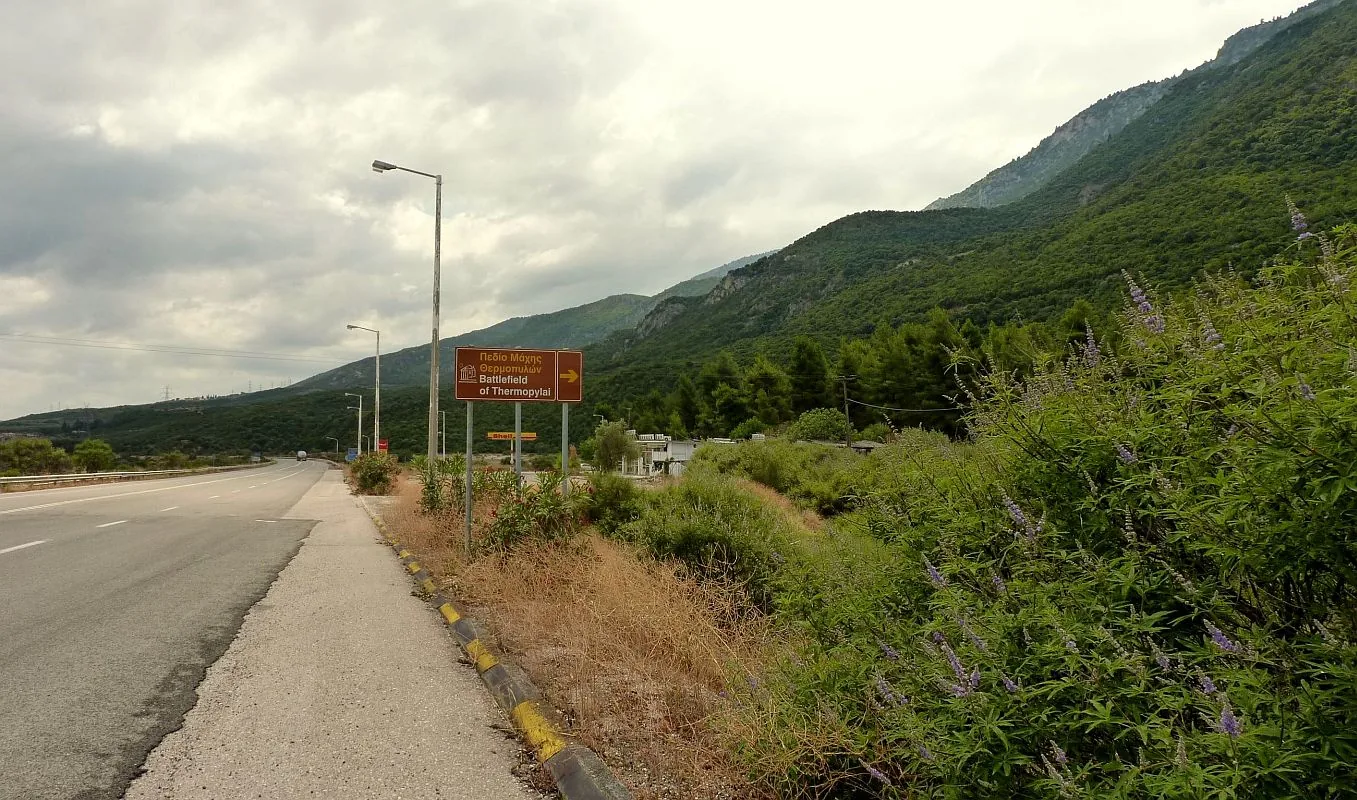
The ancient shoreline differed substantially from today's broad coastal plain because sediment has extended the land. A modern map is therefore useful for regional context but cannot show the ancient tactical landscape without reconstruction. Herodotus describes narrow passages, a defensive wall, and a mountain route. These features matter more for understanding the choice of position than the exact modern location of a commemorative statue. The battle's precise calendar dates within 480 remain debated.[1][3]
The people behind the three hundred
Leonidas I commanded a force containing three hundred Spartiates and several thousand other Greeks. Herodotus lists contingents from the Peloponnese and central Greece, including Thespians, Thebans, Phocians, and Locrians. Numbers and participation changed during the operation. The famous Spartan contingent was therefore part of a coalition whose contributions should be named. The defense also depended on people carrying supplies and performing tasks that receive less attention in the heroic narrative.
Herodotus connects the limited advance mobilization with religious festivals and the expectation that more forces would follow. He reports that Leonidas chose men with living sons, a detail that later readers have used to infer expectations about survival. Such an inference is plausible but should not become a claim that we know every defender's orders or private intentions. Ancient troop totals, especially those assigned to the Persian invasion, also require critical assessment rather than simple repetition.[1]
Outflanking and the final fighting
The defenders initially resisted attacks in the constricted terrain. Herodotus describes the Spartans using controlled retreats and renewed attacks, presenting discipline as a decisive advantage. Persian troops then followed a mountain path identified with information from Ephialtes. The Phocian force guarding the route was bypassed, and the defenders at the pass faced the prospect of attack from behind. A strong frontal position had become vulnerable through the wider landscape.
Most of the Greek army departed before the final action. Leonidas and his Spartans remained, together with the Thespians and others. Herodotus' explanation of the Thebans' presence is hostile and remains contested. Leonidas died in the fighting, and the remaining resistance was overwhelmed. The evidence does not securely establish a single reason why each group stayed. Protecting withdrawal, civic obligations, religious expectations, and the immediate military situation all belong in the discussion.[1]
Defeat, commemoration, and historical scale
The Persian army passed through Thermopylae and continued south. Greek resistance nevertheless survived, with the naval victory at Salamis later in 480 and the land victory at Plataea in 479 changing the outcome of the invasion. It is difficult to measure exactly how much time Thermopylae gained or how that delay affected later decisions. A commemorative narrative of necessary sacrifice is not the same as a demonstrable chain of strategic causation.
Memorial inscriptions and later retellings made the pass a powerful example of endurance under obligation. Modern versions often turn the encounter into a simple opposition between freedom and tyranny, overlooking the variety of Greek alignments and Sparta's own domination of helots. Recognizing these complications does not deny the courage of the defenders. It places that courage within the political and social world in which they lived, and restores the allies whose deaths became overshadowed by the enduring image of the three hundred.[1][2]
FOLLOW THE EVIDENCE
References & further reading
- Ancient textHerodotus, Histories 7.175–239 ↗
A. D. Godley translation, public domain. The Thermopylae narrative and the account of Gorgo interpreting Demaratus' message.
- Ancient textThucydides, History of the Peloponnesian War ↗
Richard Crawley translation, public domain. A contemporary source for the late fifth-century BCE conflict, with retrospective accounts of earlier events.
- Modern scholarshipLivius: Thermopylae, 480 BCE ↗
Historical and geographical overview of the pass and the Persian invasion.