On this page
The phalanx in a wider Greek world
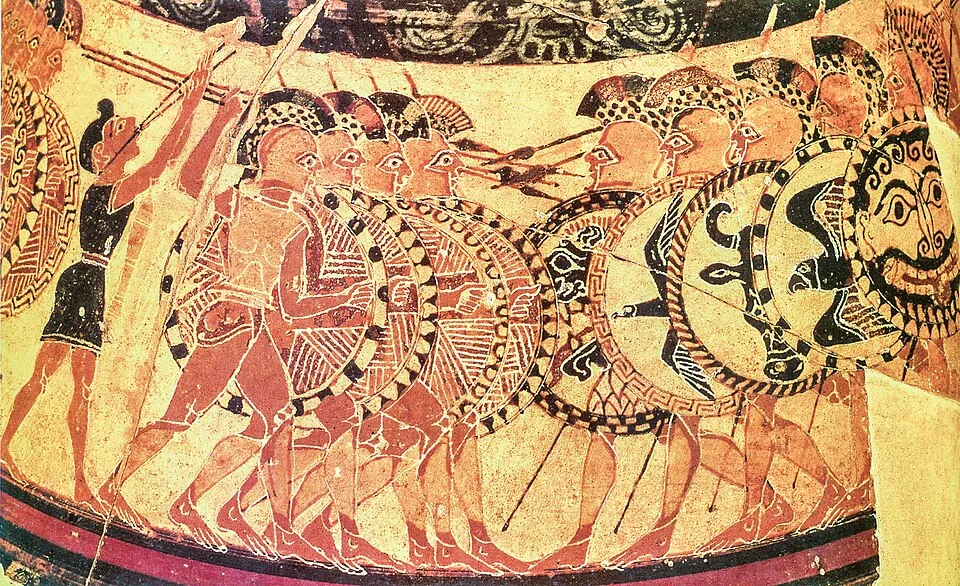
Spartan armies are best known for the phalanx, a formation of heavily equipped infantry arranged in ranks and files. Hoplites carried shields and spears and depended on coordinated movement and mutual support. This form of fighting was shared across the Greek world; Sparta did not possess a uniquely Spartan weapon that made victory automatic. Its distinction lay more in the reputation of its soldiers, the organization of command, and the social practices associated with maintaining discipline.
The formation was not identical in every period or battle. Depth, frontage, equipment, and the relationship between close combat and maneuver varied. Modern debate also concerns the physical meaning of the pushing described in ancient battle narratives. It is unwise to imagine every encounter as a uniform mass scrum or, at the opposite extreme, as isolated duels. Terrain, morale, missile fire, and the behavior of neighboring units affected what soldiers could do.[2][1]
Command, units, and movement
Xenophon describes a hierarchy of officers and subdivisions, including the mora and smaller units such as the enomotia. Commands passed through subordinate leaders who had responsibility for forming, moving, and re-forming their men. His interest in drill highlights the value of being able to change formation without losing order. A king might lead a major campaign, but the army's operation depended on many officers and on the ability of ordinary soldiers to recognize instructions.
Unit strengths cannot be assigned one fixed number valid for all Spartan history. Sources from different decades describe different arrangements, and a levy might include only specified age classes. Casualties and the declining citizen population also affected actual strength. Thucydides' account of Mantinea in 418 BCE illustrates both the sophistication and the limits of command: orders issued during the approach did not all produce the intended result. Organization increased options without eliminating confusion.[1][2]
Who served and sustained the army
The army included perioikoi, allies, and, in some contexts, helots or freed former helots. A force called Lacedaemonian should not automatically be counted as entirely Spartiate. Allied contingents could make up much of a coalition, while servants, carriers, and other workers supported those who fought. The food and time available to citizen soldiers depended on agricultural labor performed by subordinated people. Military institutions were embedded in an unequal society rather than separate from it.
Sparta also used cavalry, light troops, mercenaries, and naval forces. Their importance changed as warfare spread across varied landscapes and longer campaigns. Brasidas' northern expedition and Lysander's naval commands are reminders that Spartan strategy could reach well beyond a hoplite battle in the Peloponnese. The destruction of a Spartan unit by Iphicrates' light troops near Lechaeum in 390 BCE demonstrated that disciplined heavy infantry could be vulnerable to opponents who refused close engagement.[3][2]
Reputation, defeat, and adaptation
Spartan cohesion could intimidate opponents before a battle began, and victories helped sustain that reputation. Yet the surrender on Sphacteria in 425 BCE and the defeat at Leuctra in 371 showed its limits. Morale and expectations mattered, but neither prevented exhaustion, encirclement, or the loss of key commanders. Explanations that attribute every victory to training and every defeat to exceptional betrayal cannot account for the actual diversity of the military record.
By the Hellenistic period the army operated among larger kingdoms, federal leagues, and mercenary markets. Reforms associated with Cleomenes III changed recruitment and equipment as part of a broader reconstruction of the citizen body. The Spartan army should therefore be studied as a succession of institutions responding to manpower, resources, and political aims. Its celebrated phalanx remains important, but the people who supplied, commanded, financed, and supplemented it are equally necessary to understand how it functioned.[3][4]
FOLLOW THE EVIDENCE
References & further reading
- Ancient textXenophon, Constitution of the Lacedaemonians ↗
H. G. Dakyns translation, public domain. An admiring fourth-century BCE account of Spartan institutions.
- Ancient textThucydides, History of the Peloponnesian War ↗
Richard Crawley translation, public domain. A contemporary source for the late fifth-century BCE conflict, with retrospective accounts of earlier events.
- Ancient textXenophon, Hellenica ↗
H. G. Dakyns translation, public domain. Covers the later Peloponnesian War and Greek affairs down to 362 BCE.
- Ancient textPlutarch, Life of Cleomenes ↗
Bernadotte Perrin translation, public domain. A sympathetic later biography; compare its account of the war with Polybius.