On this page
The failure of a common peace
In 371 BCE Greek states attempted to establish another common peace. A central dispute concerned whether Thebes could represent the other Boeotian communities or must allow them to enter separately. The issue involved competing claims about autonomy and regional organization, not simply a disagreement over diplomatic wording. Thebes was excluded from the settlement, and the Spartan king Cleombrotus I led an army into Boeotia.
Cleombrotus was Agesilaus II's colleague in the dual kingship, not the regent Cleombrotus associated with the aftermath of Thermopylae a century earlier. His army included Lacedaemonians and allies whose enthusiasm for Spartan policy varied. Xenophon depicts pressure on the king to show that he was willing to fight the Thebans. The campaign therefore combined a public claim to enforce a settlement with concerns about authority, reputation, and the cohesion of the alliance.[1][3]
A concentrated Theban attack
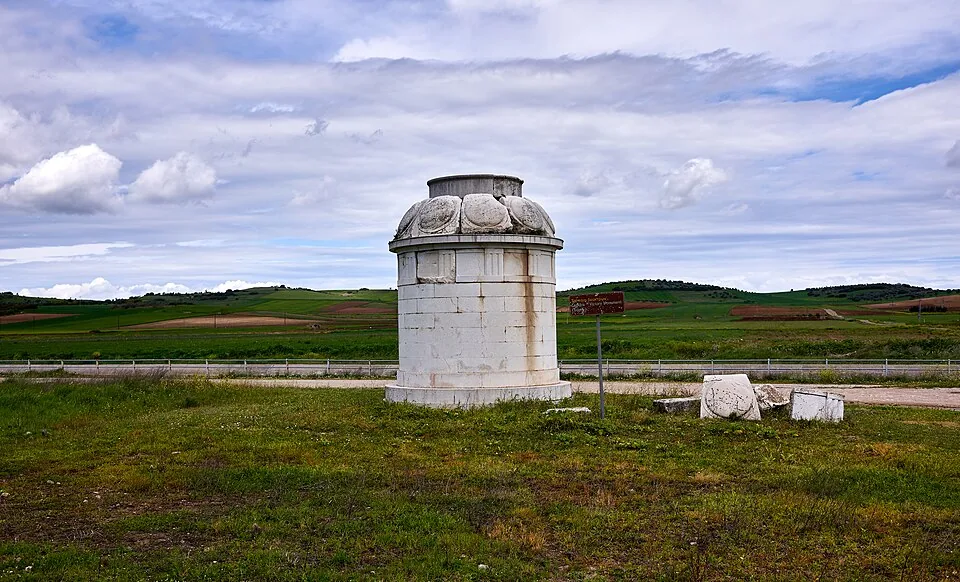
The armies met near Leuctra in Boeotia. The Thebans concentrated a particularly deep formation on their left, opposite the Spartan right where the king and leading Spartan troops stood. Xenophon describes this depth and emphasizes the Thebans' calculation that defeating the strongest part of the opposing army would decide the encounter. Cavalry action also contributed to the disruption of the Spartan line before the infantry struggle became decisive.
Later narratives give Epaminondas and Pelopidas prominent roles in explaining Theban success. The familiar modern image of an entirely new oblique order can make the tactical evidence seem more complete than it is. Formation depth, sequencing, and the degree to which other units were held back remain matters of reconstruction. What is clear is that the Thebans concentrated force against a crucial part of the enemy rather than matching every section of the opposing line equally.[1][4]
A king's death and a costly defeat
Cleombrotus was mortally wounded, and the fighting around the Spartan right produced severe losses. Xenophon reports that roughly four hundred of the seven hundred Spartiates present were killed, within a larger Lacedaemonian loss. These are ancient reported figures, not modern audited totals, but they convey the disproportionate damage to a small full-citizen population. Losing experienced men and a king in one battle had consequences beyond the immediate tactical defeat.
The surviving commanders considered whether to continue the struggle, but allied discouragement and the condition of the army favored withdrawal. The victors controlled the field, and the Spartans had to seek the return of their dead under a truce. Such conventions made defeat publicly visible. Xenophon's account of the restrained official response at Sparta also belongs to the city's culture of managing grief and reputation; it should not be mistaken for evidence that families felt no loss.[1][3]
A turning point, not the end of Sparta
Leuctra destroyed the expectation that Spartan leadership could be maintained by the threat of a superior citizen army. It encouraged opponents within and beyond the Peloponnese and helped make possible the later invasion of Laconia. The liberation of Messenia and foundation of Messene in 369 BCE converted military defeat into a lasting territorial and economic transformation. Those developments required further campaigns and political choices; they did not occur automatically on the battlefield itself.
Sparta survived and remained an active state. It defended its city, pursued alliances, and later attempted major reforms. Calling Leuctra the end of Sparta therefore obscures centuries of subsequent history. Its importance is more precise: it broke the basis of a particular kind of dominance and exposed the weakness created by a narrow citizen body ruling extensive territory. The battle joins tactical concentration to the deeper questions of manpower, allied consent, and dependence on subordinated labor.[1][2]
FOLLOW THE EVIDENCE
References & further reading
- Ancient textXenophon, Hellenica ↗
H. G. Dakyns translation, public domain. Covers the later Peloponnesian War and Greek affairs down to 362 BCE.
- Ancient textPlutarch, Life of Agesilaus ↗
Bernadotte Perrin translation, public domain. Compare this later biography with Xenophon's contemporary but admiring account.
- Ancient textXenophon: The Battle of Leuctra, 371 BCE ↗
Public-domain translated extract of Hellenica 6.4, with editorial introduction. A convenient focused reading of the principal contemporary narrative.
- Modern scholarshipThe Cambridge History of Greek and Roman Warfare: Battle ↗
Scholarly chapter examining Greek battlefield practices and the traditional model of hoplite warfare; linked chapter summary.