On this page
From Leuctra to the Peloponnese
The Theban victory at Leuctra in 371 BCE weakened Spartan authority and encouraged opponents to organize. During the following campaigns, Epaminondas and his allies entered the Peloponnese and invaded Laconia. The appearance of a hostile army near Sparta exposed the limits of the city's former military security. Yet defeating Sparta in battle and dismantling its territorial system were different tasks. Lasting change required new political arrangements capable of surviving the departure of the invading coalition.
Messenia was central because Spartan control of its land and agricultural labor had supported citizen privilege for generations. Ending that control would deprive Sparta of resources and create a neighboring community with a strong interest in resisting any restoration. Liberation therefore combined the aspirations of people subjected to Spartan power with the strategic aims of Thebes and its allies. These motives could reinforce one another without being identical.[2][1]
Who gained freedom and political standing
The transformation ended Spartan domination over much of Messenia and made possible an independent Messenian state. People formerly held in helot subjection gained a radically different relationship to political power and land. Pausanias describes the return of Messenians from exile and the recovery of a shared homeland. His narrative was written much later and gives the event the coherence of a national restoration, so its detailed claims about continuity require critical reading.
The population of the new state cannot be reduced to a single unchanged group that had preserved exactly the same identity over centuries. Local inhabitants, descendants of exiles, and communities with different experiences of Spartan rule contributed to its formation. Nor did liberation establish modern social equality for every resident. The most secure distinction is the end of Spartan mastery and the creation of institutions through which Messenians could act collectively on their own behalf.[1]
Founding a city beneath Ithome
The foundation of Messene is conventionally dated to 369 BCE. Its position by Mount Ithome linked defensibility with a landscape already important in stories of Messenian resistance. Fortifications made independence materially harder to reverse. A city with protected public spaces and a territorial center offered a different basis for collective life from scattered communities living under Spartan domination. Building and settlement were therefore essential parts of the political settlement, not merely decoration after victory.
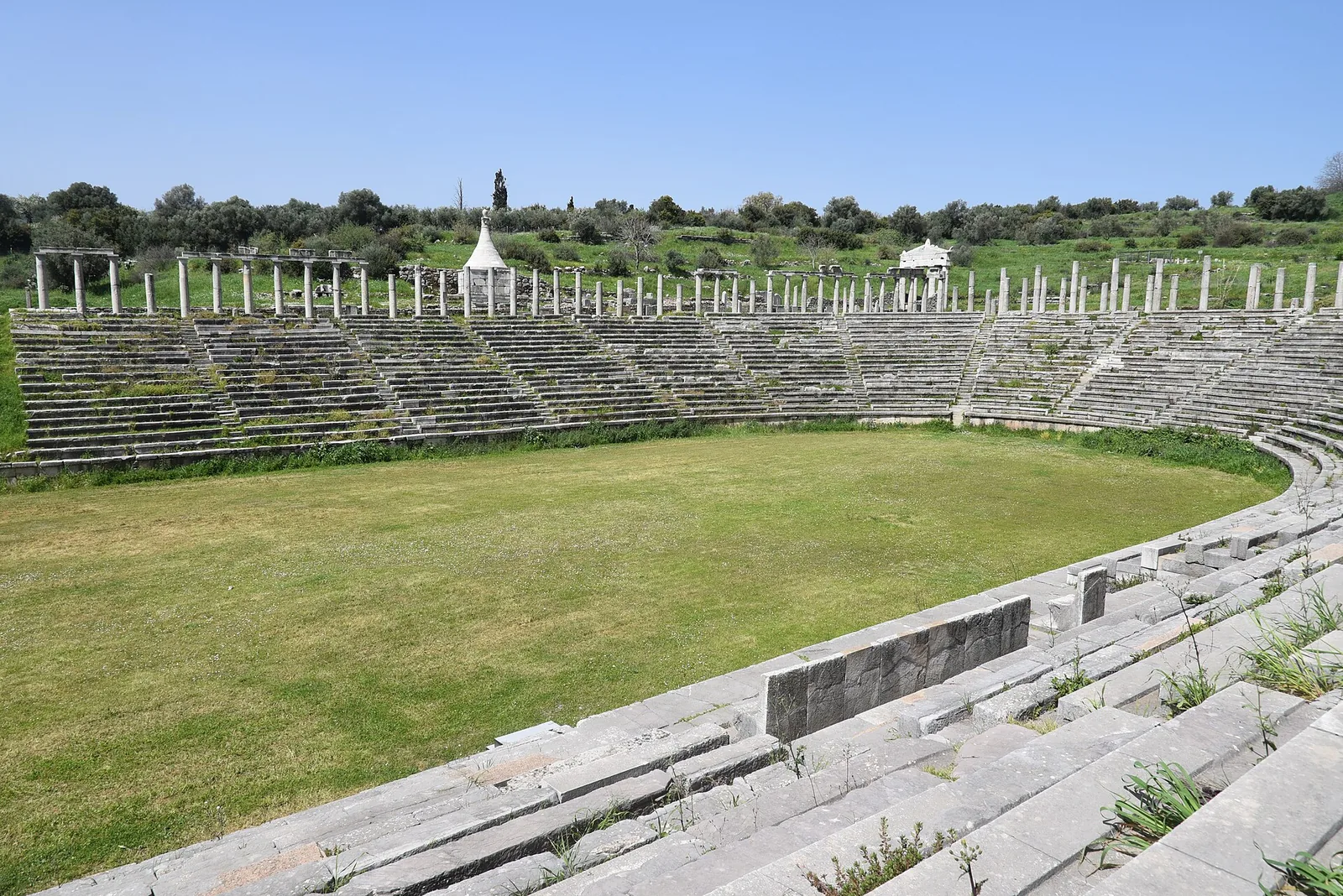
The archaeological site preserves extensive walls and public and religious buildings, though many visible structures belong to later phases. It would be inaccurate to assign every surviving monument to the founding year. Archaeology reveals the long development of an independent urban community, while Pausanias records the stories and sacred associations through which its inhabitants understood that community. Reading the two together helps distinguish the initial foundation from the prosperity, rebuilding, and commemorative choices of later centuries.[3][1]
Consequences for Sparta and Messenian memory
For Sparta, the loss meant more than a reduced area on a map. It removed access to agricultural resources and labor that had sustained full citizens and their obligations. The city remained independent, but its former dominance was much harder to rebuild. Spartan leaders continued to reject or contest the new situation in diplomacy, and the recognition of Messenian independence became an important issue in subsequent attempts to make peace.
For Messenians, liberation provided a foundation story around which earlier resistance, exile, and sacred traditions could be organized. Pausanias' detailed history demonstrates the strength of that memory in the Roman period. The event should therefore be understood both as a concrete change in power during the 370s BCE and as an enduring account of collective recovery. It marks one of the clearest moments when people subordinated by Sparta became visible as the builders of a state whose survival limited Spartan ambitions.[1][4][2]
FOLLOW THE EVIDENCE
References & further reading
- Ancient textPausanias, Description of Greece 4.20–36 ↗
W. H. S. Jones translation, public domain. Later Messenian history, exile, liberation, and the independent city.
- Ancient textXenophon, Hellenica ↗
H. G. Dakyns translation, public domain. Covers the later Peloponnesian War and Greek affairs down to 362 BCE.
- ArchaeologyUNESCO: Archaeological site of Ancient Messene ↗
Greek nomination to the Tentative List, describing the foundation, fortifications, and archaeological remains. Tentative listing is not World Heritage inscription.
- Ancient textPlutarch, Life of Agesilaus ↗
Bernadotte Perrin translation, public domain. Compare this later biography with Xenophon's contemporary but admiring account.