On this page
Protection and its compromises
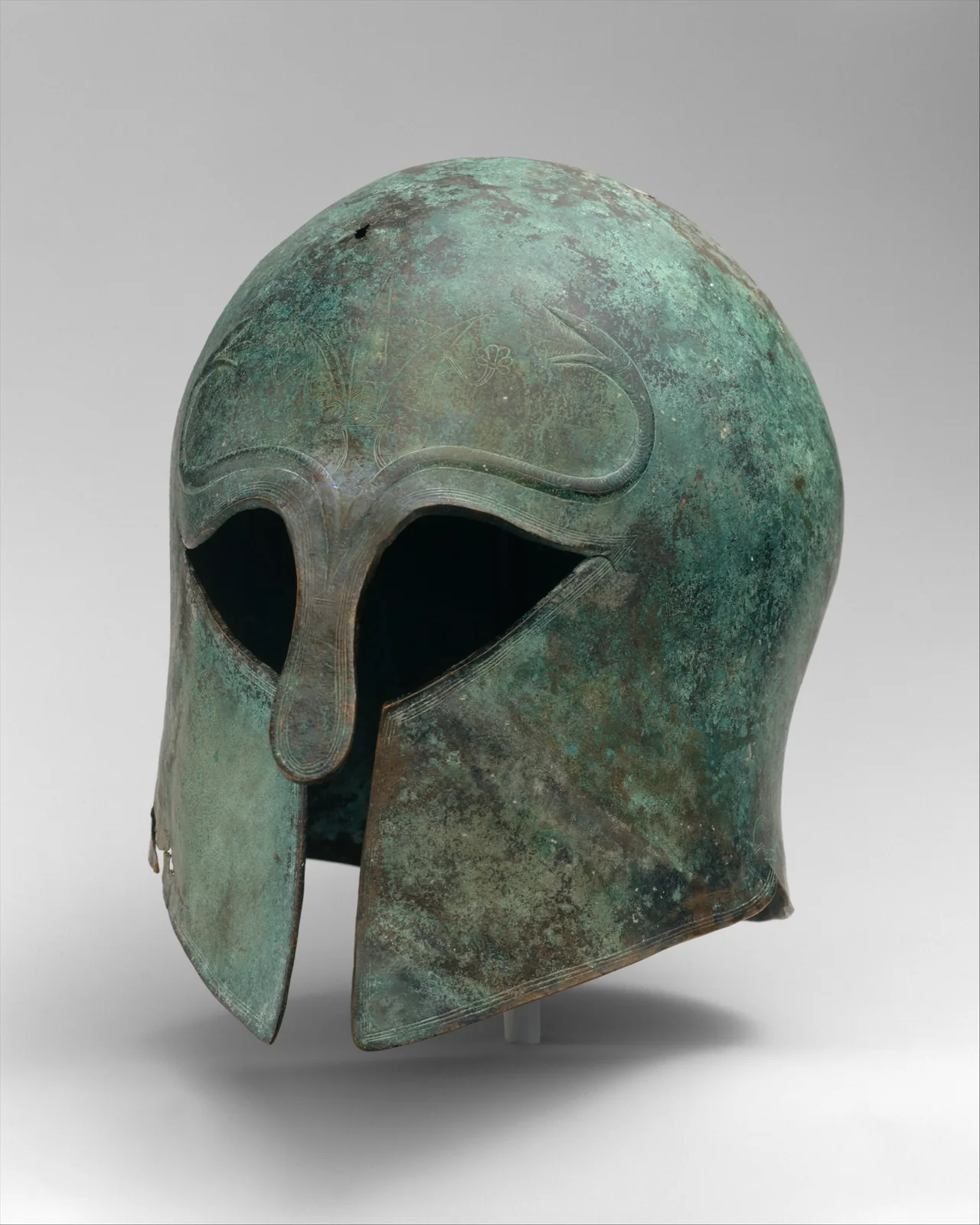
Bronze helmets could cover much of the face, while other forms left vision and hearing less restricted. Cuirasses protected the torso, and greaves covered the lower legs. The amount and kind of armor used changed over time and could vary among individuals. Weight, heat, mobility, expense, and the expected kind of fighting all mattered. It would be misleading to equip every Spartan from the seventh to the third century BCE with an identical complete bronze outfit.
Museum objects supply physical evidence that literary descriptions cannot: construction, repairs, decoration, and the dimensions of surviving pieces. Yet a display of elite or unusually well-preserved armor may not represent what an entire army wore. Objects dedicated in sanctuaries could be trophies taken from enemies, and artistic scenes could emphasize heroic display. To reconstruct a battlefield, historians must compare material remains with texts rather than treating any single object or image as a complete uniform guide.[3][4]
Appearance, recognition, and symbolism
Xenophon associates Spartan soldiers with crimson clothing and carefully maintained equipment. He interprets aspects of their appearance within an account of discipline and confidence. Long hair and ritual preparation could contribute to the impression an army made on observers, but a literary explanation of why a custom existed is not necessarily its historical origin. The clothing of a soldier on campaign also needs to be distinguished from the minimal clothing described in stories about boys' upbringing.
The lambda, the initial letter of Lacedaemon, is now strongly associated with Spartan shields. Evidence for collective shield signs belongs to particular contexts and should not be projected indiscriminately into earlier periods. Modern illustrations that give every warrior at Thermopylae an identical lambda shield claim more certainty than the record permits. Shields could communicate personal, civic, or religious associations, and their painted surfaces rarely survive as fully as modern reconstructions suggest.[1][2]
Equipment within an economy of war
Weapons required raw materials, skilled labor, exchange, and maintenance. The picture of citizen warriors living apart from craft production does not mean that Sparta lacked craftspeople. Perioikic communities and broader trading networks helped supply the needs of the Lacedaemonian state. The exact organization of individual workshops is often uncertain, but an army could not remain effective through courage alone. Broken shafts, worn fittings, food supplies, and transport created continuing practical demands.
Equipment also changed with recruitment and strategy. Light-armed troops, cavalry, and naval crews did not carry the same burdens as hoplites, while Hellenistic armies introduced different tactical requirements. A useful account therefore asks whose equipment is being described, at what date, and from what evidence. This approach preserves the fascination of surviving arms without reducing Spartan material culture to a single costume. Weapons were working objects within a changing society, as well as powerful symbols in its later memory.[1][2][3]
FOLLOW THE EVIDENCE
References & further reading
- Ancient textXenophon, Constitution of the Lacedaemonians ↗
H. G. Dakyns translation, public domain. An admiring fourth-century BCE account of Spartan institutions.
- Ancient textThucydides, History of the Peloponnesian War ↗
Richard Crawley translation, public domain. A contemporary source for the late fifth-century BCE conflict, with retrospective accounts of earlier events.
- ArchaeologyThe Met: Helmet of the Corinthian Type and Pair of Greaves ↗
Museum collection record for surviving Greek bronze armor. A comparative Greek example, not an object securely attributed to a Spartan soldier.
- ArchaeologyGreek Ministry of Culture: Weaponry ↗
Museum-based presentation of Greek and Persian equipment for the Persian Wars commemorative exhibition.