On this page
Before the familiar institutions
Early Sparta is difficult to reconstruct because the most detailed surviving descriptions concern a much later society. The discipline, common meals, and political offices familiar from Classical accounts cannot simply be projected backward in their finished form. A community had to develop through settlement, local relations, religious practice, and competition for resources. This was a historical process, not necessarily a constitution introduced all at once.
The broader Laconian region had an important Bronze Age past, but the relationship between Mycenaean centers and the later city needs careful treatment. Stories of Menelaus and Helen gave subsequent inhabitants access to the heroic world. They do not establish that the institutions of Classical Sparta already existed in the Bronze Age. Material remains and later legendary narratives answer different questions, even when they concern the same landscape.[1][3]
Settlements becoming a community
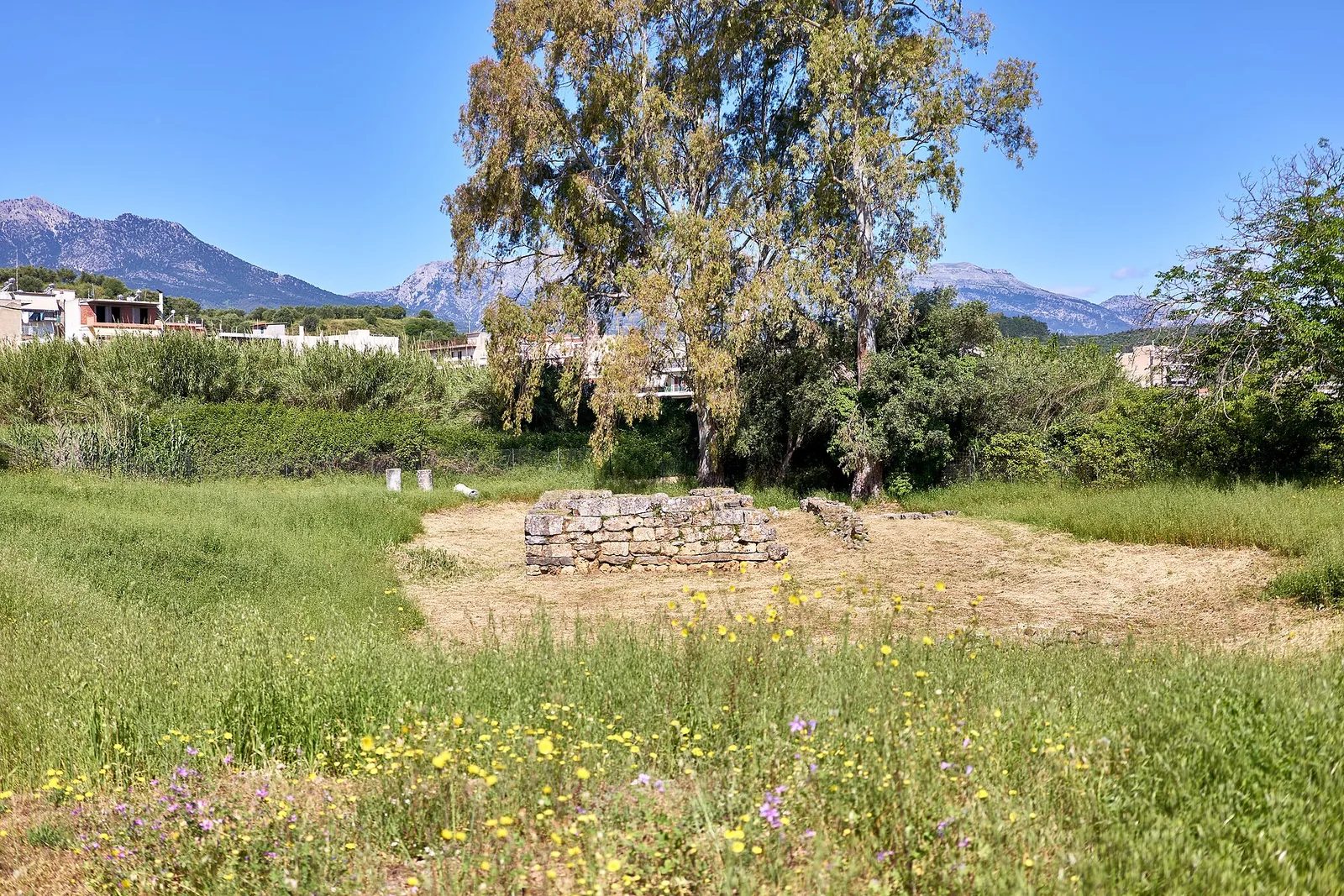
The historical city retained an organization associated with several constituent districts. Amyclae, some distance south of the principal settlement, had a particularly important role and its own sacred traditions. Ancient accounts connect its incorporation with Teleclus, although the chronology and character of the process remain uncertain. The political community need not have formed through the sudden physical concentration of every inhabitant in a single urban center.
Shared worship could connect settlements while preserving local distinctions. Sanctuaries attracted offerings and gatherings, creating opportunities for collective display and interaction. Such activity is visible archaeologically even where political events are obscure. The growth of a sanctuary does not automatically prove the existence of a particular office, law, or social class. It does, however, provide evidence that communities were investing resources in places whose significance extended beyond an individual household.
Later tradition distinguished the settlements of Pitana, Mesoa, Limnae, and Cynosura, with Amyclae retaining a particular place in the wider community. Such names preserve a settlement geography rather than a securely dated record of political unification.[1][3]
The problem of Lycurgus
Ancient writers commonly attributed Sparta's distinctive arrangements to Lycurgus. Plutarch opens his biography by acknowledging disagreement about the lawgiver's ancestry, travels, legislation, and date. That admission is a useful starting point. The figure of a founder could make a changing collection of practices appear as a coherent ancestral order. It could also authorize later reforms by presenting them as restoration rather than innovation.
This does not mean that every tradition is worthless or that no early reform ever occurred. It means that the evidence rarely allows a precise division between an individual's actions and the accumulation of institutions over time. Early Sparta should be read through converging kinds of evidence: settlement remains, offerings, poetry, comparative institutions, and cautiously interpreted narratives. The result is less dramatic than a single founding moment but more informative. It presents a community becoming powerful through sustained relationships with its landscape, its neighbors, and the people whose work supported its citizens.[2][3]
FOLLOW THE EVIDENCE
References & further reading
- Ancient textPausanias, Description of Greece, Book 3.1–13 ↗
Royal traditions and the description of Sparta. A Roman-era account, not a contemporary record of the Archaic period.
- Ancient textPlutarch, Life of Lycurgus ↗
Bernadotte Perrin translation, public domain. Written centuries after Classical Sparta; anecdotes and institutional origins are not independently verified by their inclusion.
- Modern scholarshipEarly Sparta c. 950–650: An Archaeological and Historical Study ↗
Oxford Research Archive record for a study combining the material and literary evidence for early Sparta.