On this page
A kingdom seeking renewal
Agis IV became king in the middle of the third century BCE, conventionally around 244. He inherited a Sparta far removed from its fifth-century dominance. Messenia had long been independent, Macedonian power shaped Greek affairs, and the full citizen body had contracted. Concentrated property and the costs of maintaining citizen status were central to later explanations of this weakness. Agis proposed social changes intended to rebuild the community's manpower and recover its standing.
Our principal narrative is Plutarch's Life of Agis, written centuries later and shaped by admiration for a young reformer. Its portrait of luxury, decline, and ancestral virtue should be read as an interpretation, not a neutral census. Aristotle's earlier criticism of Spartan property arrangements nevertheless shows that inequality and exclusion were not problems invented solely by Hellenistic reform propaganda. The challenge is to connect the sources without assuming that conditions remained identical across the intervening generations.[1][3]
Debt cancellation and land division
Agis' program combined the cancellation of debts with a redistribution of land and an enlargement of the citizen body. Plutarch describes a scheme involving forty-five hundred allotments for Spartans and fifteen thousand in the wider territory. These are reported features of a proposal, not secure population totals. The intended addition of suitable men from outside the existing citizen group would have increased the number available for military service and common civic obligations.
The program was presented as a restoration of the laws of Lycurgus. That language gave radical change the appearance of ancestral legitimacy, but it does not prove that early Sparta had once possessed the exact equal distribution envisaged. Debt relief and redistribution also affected different interests in different ways. A heavily indebted landowner might welcome the first while resisting the second. Treating both measures as a single universally popular reform misses the tensions within the coalition supporting Agis.[1][4]
Supporters, rivals, and a stalled reform
Agis secured support from influential associates, including his uncle Agesilaus and an ephor named Lysander, who must not be confused with the naval commander of the previous century. His mother Agesistrata and grandmother Archidamia appear in Plutarch as wealthy supporters willing to contribute resources. Their role illustrates how elite women could affect political struggles through property and family networks even though they did not hold the public offices through which the measures had to pass.
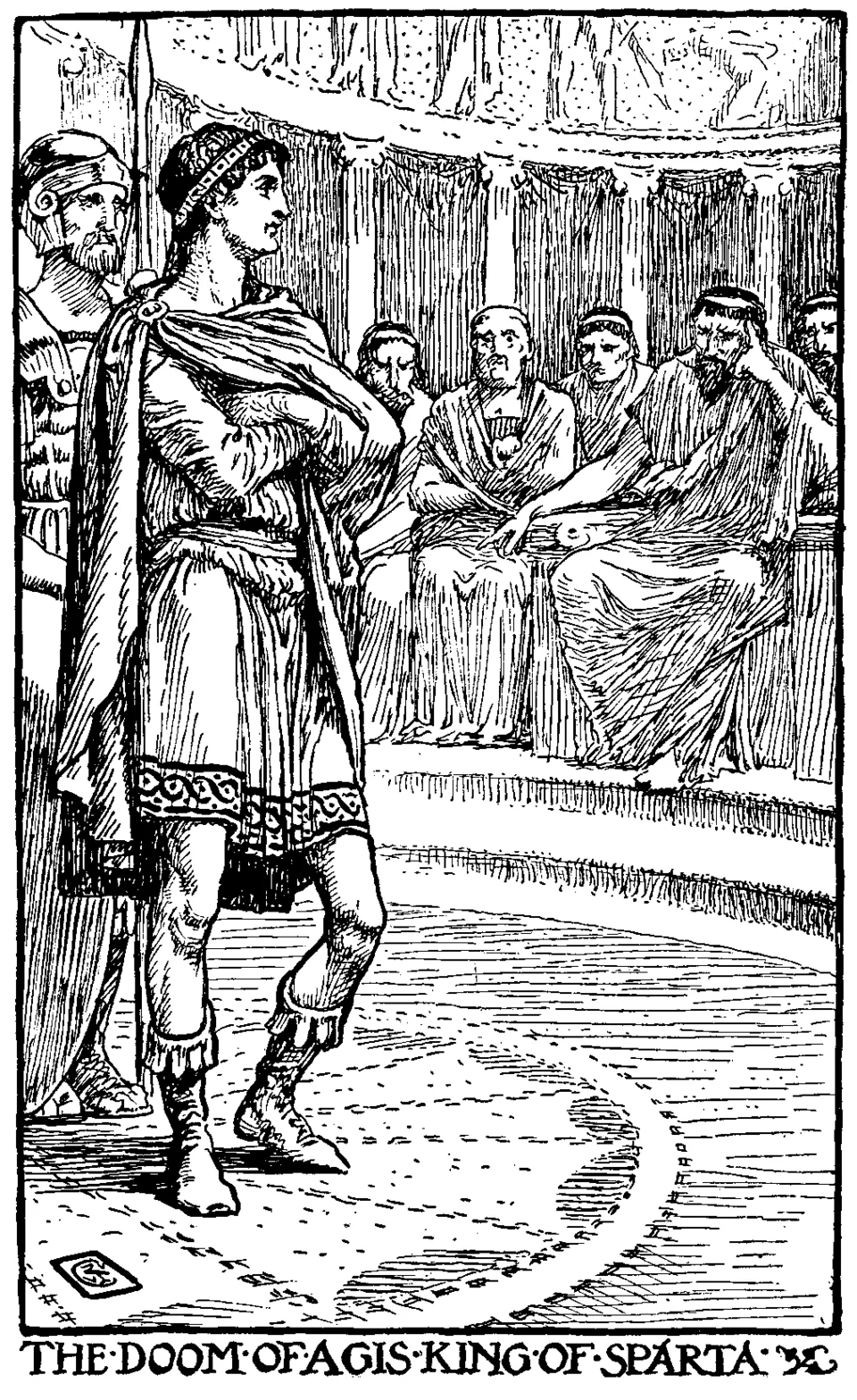
The other king, Leonidas II, became a focus of opposition and was temporarily displaced. Debt records were destroyed, but the division of land did not follow. Plutarch blames Agesilaus for delaying redistribution after benefiting from the cancellation of his own debts. Agis' absence on a military expedition created further opportunities for opponents. The narrative makes personal character important, yet institutional rivalry, property interests, and the difficulty of sustaining a reform coalition were equally consequential.[1]
Execution and a contested inheritance
Leonidas returned to power, and Agis sought sanctuary before being seized and imprisoned. In 241 BCE he was executed after a proceeding Plutarch presents as coercive and unjust. His mother and grandmother were also killed. The deaths underline the violence that could accompany disputes within the citizen elite. Spartan kingship did not protect a ruler once his opponents controlled the institutions and force needed to act against him.
Agis' widow Agiatis was subsequently married to Cleomenes, the son of Leonidas II. Plutarch makes her memories of Agis an influence on the later reforming king, although the private conversations in that story cannot be independently recovered. Cleomenes would employ more direct violence and achieve changes that Agis had failed to implement. Agis' legacy therefore lies both in an unfinished program and in the moral example later writers constructed from it: an attempt to renew a privileged citizen community whose beneficiaries were never intended to include everyone living under Spartan rule.[1][2]
FOLLOW THE EVIDENCE
References & further reading
- Ancient textPlutarch, Life of Agis ↗
Bernadotte Perrin translation, public domain. A later narrative of reform, social conflict, and the king's execution.
- Ancient textPlutarch, Life of Cleomenes ↗
Bernadotte Perrin translation, public domain. A sympathetic later biography; compare its account of the war with Polybius.
- Ancient textAristotle, Politics, Book 2.9 ↗
Benjamin Jowett translation, public domain. Aristotle evaluates the Spartan constitution critically, including property, women, offices, and common meals.
- Modern scholarshipThomas W. Africa, Stoics, Cynics, and the Spartan Revolution ↗
Scholarly discussion of the reform movement and its ideological setting. The linked extract summarizes the contrast between Agis and Cleomenes.