On this page
A sacred place in the Spartan landscape
The sanctuary of Artemis Orthia lay in the Limnai area of Sparta, near the Eurotas. Its location connected it with one part of the settlement while its importance extended across the community. Orthia was an old cult title associated with Artemis, but the relationship between a local sacred figure and the more widely recognized goddess developed within a history that cannot be reconstructed completely. A divine name could gather local traditions rather than simply replace them.
Pausanias records stories about the sanctuary's image and the origins of its rites. Such narratives explain why a place was powerful and why its observances demanded respect. They should not be read as straightforward eyewitness reports of the earliest cult. The sanctuary's authority rested partly on remembered antiquity, while the actual ceremonies encountered by a Roman-era traveler belonged to a much later setting.[1]
Offerings and religious participation
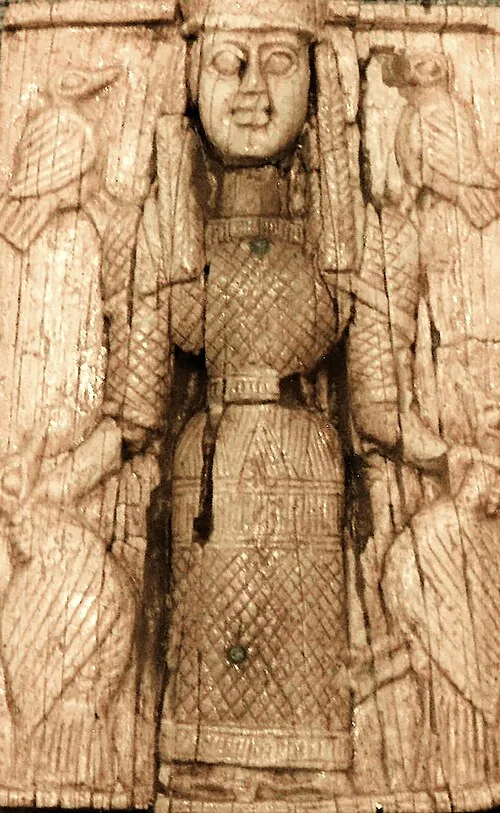
Excavation at Orthia recovered numerous small dedications, including lead figurines, terracotta masks, and carved objects. Their variety offers a different view of Sparta from accounts concentrated on constitutions and warfare. A dedication records an act of engagement with a sacred place, although it rarely tells us everything about the person who made it. Repeated offerings can reveal patterns of practice without supplying a complete social census of worshippers.
The sanctuary also demonstrates why material culture should not be reduced to an illustration of literary texts. Some finds may invite comparison with ritual or performance, but the exact use of an object is not always certain. A mask, for example, can suggest a performative setting without proving a detailed reconstruction of a ceremony. Archaeology and ancient description become most useful when their differences are acknowledged and each is allowed to test the other.[4][1]
Upbringing and endurance
Ancient testimony connects Orthia with activities involving boys, competition, and physical endurance. Xenophon describes the stealing of cheeses from the altar while others were appointed to whip the participants. He presents the practice within his account of upbringing and the cultivation of resourcefulness and persistence. The description is important, but it should not be turned into a complete account of every rite at the sanctuary or every child's experience.
Later accounts emphasize the endurance of whipping, and Plutarch claims to have seen extreme suffering in this setting. The Roman-era spectacle developed a fame of its own. A key historical question is how these later contests related to earlier practices. Continuity of place and divine association does not prove that the form, audience, or meaning of the event stayed the same. Later Spartans could preserve a ritual name while adapting its performance to new circumstances.[2][3]
A sanctuary with a long life
The history of Orthia includes successive construction and alteration, rather than one building that remained untouched from the Archaic age. Later facilities for spectators changed the relationship between participants and audience. Such development belongs to the wider history of Sparta's celebrated past becoming a resource in the Roman world. It does not make later ritual unreal; it makes it evidence for the society that performed it.
Orthia is consequently central to several connected histories: local worship, childhood, artistic production, communal identity, and the reception of Spartan discipline. Its most sensational rites should not eclipse its long record of dedication and ordinary religious engagement. Studying the sanctuary requires moving between the voices of ancient authors and the objects left by many unnamed people. That combination shows a sacred place continually invested with meaning, whose importance cannot be captured by a single story of toughness or by the assumption that every unusual custom was unchanged from the time of Lycurgus.[1][4][3]
FOLLOW THE EVIDENCE
References & further reading
- Ancient textPausanias, Description of Greece, Book 3 ↗
The second-century CE travel account of Laconia. Its monuments and local traditions belong to the author's time and require comparison with earlier evidence.
- Ancient textXenophon, Constitution of the Lacedaemonians ↗
H. G. Dakyns translation, public domain. An admiring fourth-century BCE account of Spartan institutions.
- Ancient textPlutarch, Life of Lycurgus ↗
Bernadotte Perrin translation, public domain. Written centuries after Classical Sparta; anecdotes and institutional origins are not independently verified by their inclusion.
- ArchaeologyBritish School at Athens: Sparta Begins ↗
Deborah Harlan's account of the 1906–1910 excavations, illustrated from the photographic archive.