On this page
Regency and the victory at Plataea
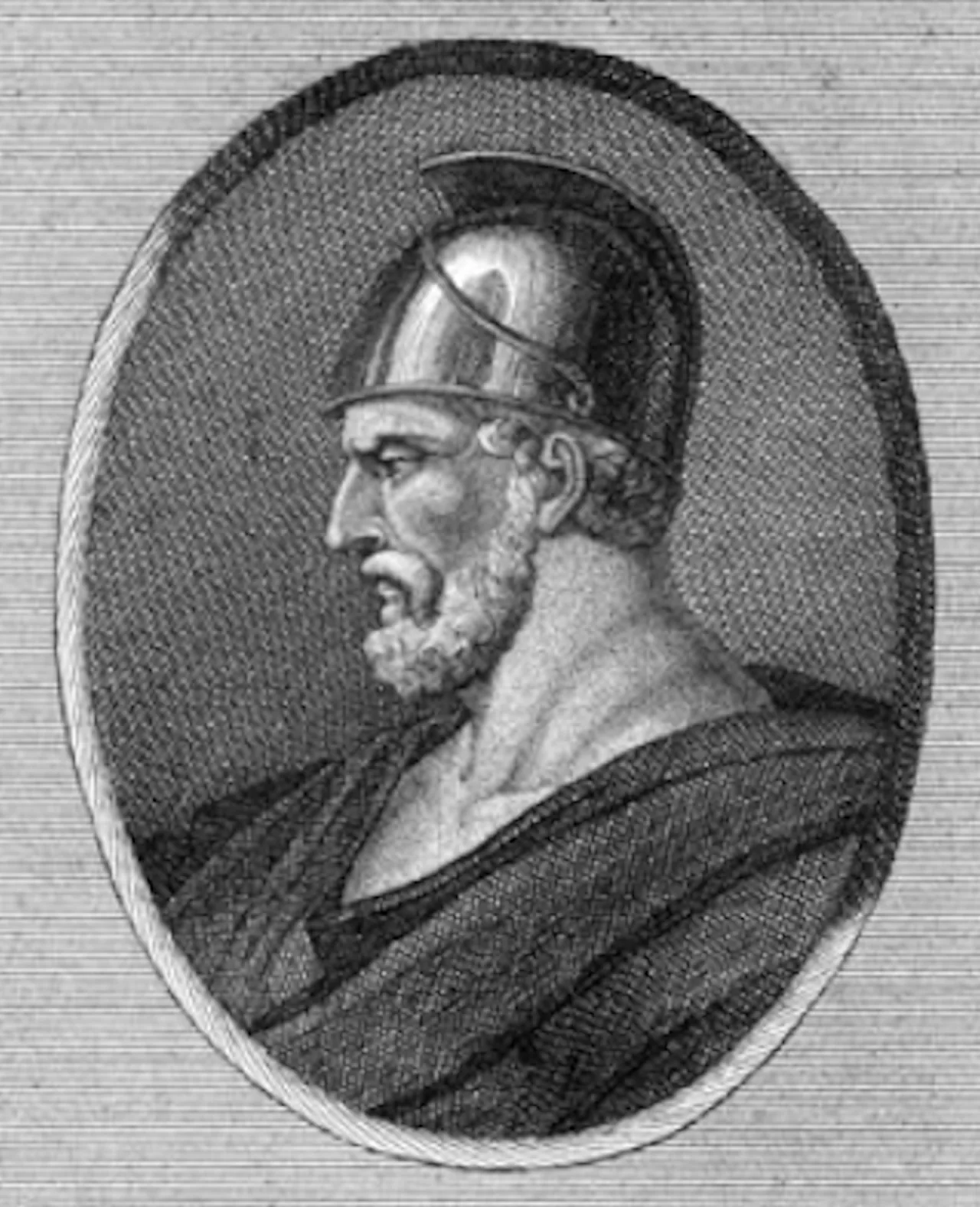
Pausanias was a member of the Agiad royal house, the son of Cleombrotus and nephew of Leonidas I. After Leonidas' death, the kingship belonged to the young Pleistarchus. Pausanias exercised command as regent for this minor, not as a king in his own right. His position illustrates how the hereditary office could survive a battlefield death while its military responsibilities passed temporarily to another adult member of the dynasty.
In 479 BCE he commanded the Greek coalition that defeated the Persian army of Mardonius at Plataea. The victory required cooperation among communities with different interests, including a substantial Athenian contingent. Pausanias' personal prominence arose from this collective achievement. Later accusations against him should not obscure the importance of the command, but neither should the victory be treated as the work of one Spartan alone. The regent operated within an alliance whose cohesion had to be maintained.[2][3]
Command beyond the Peloponnese
In the following phase of the war Pausanias led operations in the eastern Aegean and at Byzantium. Thucydides describes growing allied resentment of his conduct, including harsh treatment and displays of authority that seemed inappropriate to a leader of independent Greeks. The resulting movement toward Athenian leadership contributed to the formation of the alliance later called the Delian League. The change reflected allied choices as well as decisions taken in Sparta.
Spartan officials recalled Pausanias to answer complaints. Thucydides distinguishes charges connected with his treatment of individuals from the more serious allegation that he was conspiring with Persia. He subsequently returned to the region without an official command, a crucial difference from his earlier position. Overseas prestige could give a successful commander resources and ambitions difficult for the home authorities to supervise. Pausanias became an unusually dramatic example of this recurring problem.[1]
Accusations, evidence, and sanctuary
Thucydides reports that Pausanias sent messages to the Persian king and entertained plans involving marriage and power over Greece. He also records allegations that the regent sought the support of helots by promising freedom and citizenship. These are accounts of accusations and secret dealings, not surviving letters whose original documents we can inspect. Thucydides organizes the narrative around the ephors' gradual acquisition of evidence and their caution before moving against a prestigious royal figure.
According to his account, an associate became suspicious because earlier messengers had not returned. A trap allowed the ephors to overhear incriminating discussion. Pausanias then took refuge in a sanctuary of Athena, where the authorities blocked him in until he was dying. They removed him before his death to avoid a death inside the sacred space, yet the act still raised questions of religious pollution. The exact year is uncertain, conventionally placed around the 470s BCE.[1]
A difficult legacy
The story makes Pausanias both a liberator of Greece and a suspected collaborator with its recent enemy. That reversal suited ancient reflection on ambition, wealth, and the corrupting effects of power. It also shows that Spartan institutions could investigate and destroy a royal commander. Kings and regents possessed special standing, but neither military success nor sacred ancestry guaranteed protection when other authorities judged their actions threatening.
Pausanias must be distinguished from two later namesakes: the Spartan king who helped settle the Athenian civil conflict in 403 BCE and the second-century CE traveler whose Description of Greece records Spartan monuments. Confusing them can produce impossible chronologies. For the regent, the narrative remains dominated by Thucydides' retrospective inquiry and later local memory. A careful account preserves the difference between documented public commands, reported clandestine ambitions, and the interpretive story that joined his victory to his downfall.[1][2]
FOLLOW THE EVIDENCE
References & further reading
- Ancient textThucydides, History of the Peloponnesian War ↗
Richard Crawley translation, public domain. A contemporary source for the late fifth-century BCE conflict, with retrospective accounts of earlier events.
- Ancient textPausanias, Description of Greece, Book 3.1–13 ↗
Royal traditions and the description of Sparta. A Roman-era account, not a contemporary record of the Archaic period.
- Ancient textHerodotus, Histories 6.56–60 ↗
Public-domain translation of the passage on the privileges, religious duties, and funerary honors of Spartan kings.