On this page
Performance at the heart of civic life
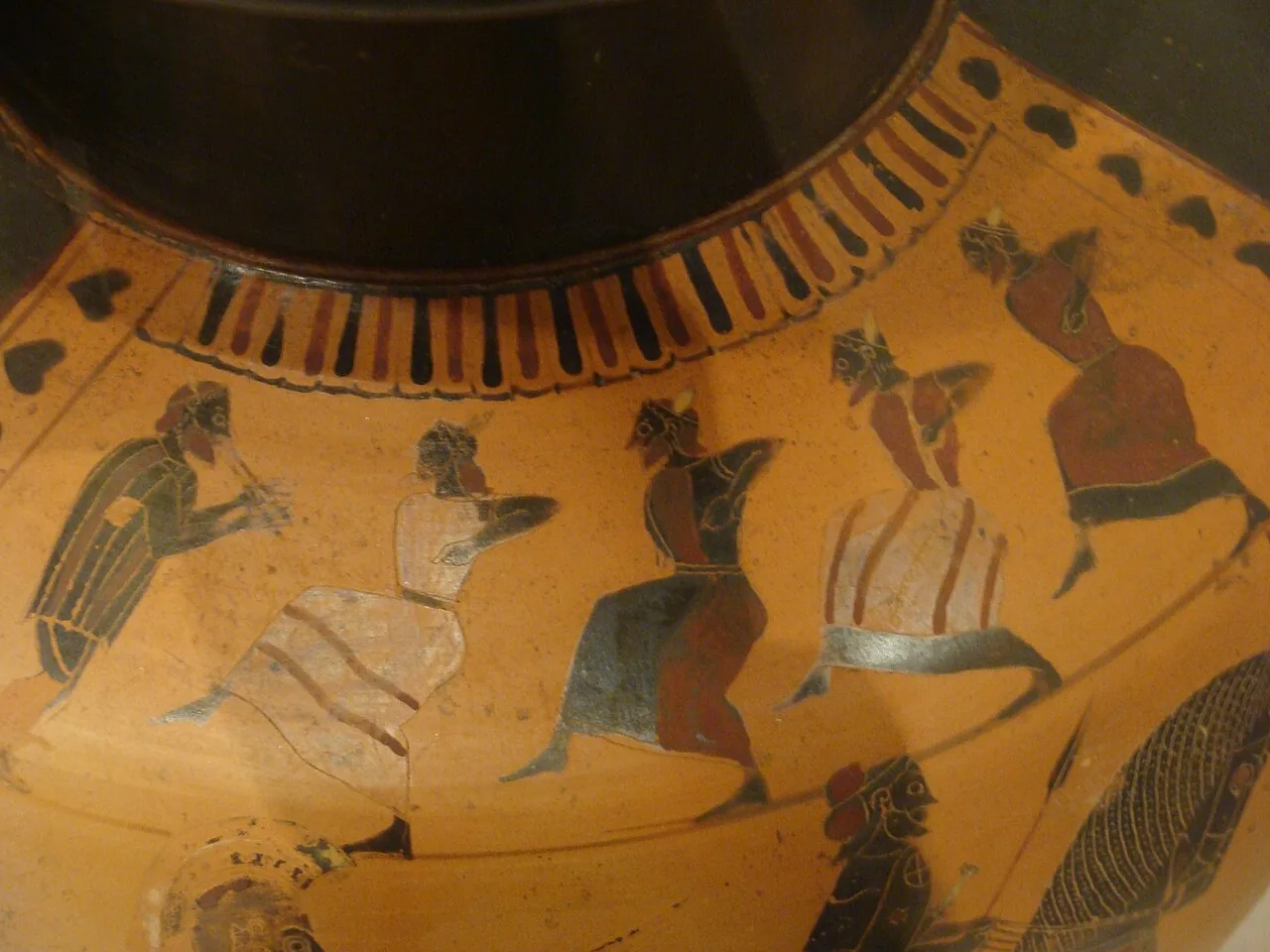
The Gymnopaedia was a major Spartan festival associated with choral performance, physical display, and the public presentation of the community. Its name is commonly connected with naked or lightly dressed youths, but the festival should not be reduced to that translation. Ancient descriptions involve different age groups and a broader setting of music, collective movement, and spectatorship. The precise program changed or is only incompletely recoverable.
Pausanias connects the performances with a public area in Sparta and records statues associated with the sacred setting. A festival in such a place joined religion to the civic landscape. Participants did not merely entertain a detached audience; they represented relationships among generations and the values attributed to the community. Spectators could recognize familiar forms, compare performers, and take part in the public judgment through which reputation was produced.[1][4]
Bodies, age, and endurance
Ancient accounts emphasize dancing and performance under demanding conditions, and later interpretations associate the festival with endurance. Physical exertion in public could display discipline without being identical to battle training. Music and coordinated movement required practice, memory, and attention to others. These were cultural skills as well as forms of bodily control. The festival therefore helps explain why education, athletics, and song overlap in Spartan history.
Age groups gave performance a generational dimension. Young participants could be seen in relation to adults and elders, making the continuity of the citizen body visible. The details of particular choruses and songs are not equally secure, especially when late compilations are used to reconstruct early practice. Nevertheless, the broader significance is clear: collective identity was enacted by people whose place in the community depended partly on age, recognition, and the fulfillment of public expectations.[4][3]
Memory and the aftermath of Leuctra
The festival could intersect dramatically with political events. Xenophon reports that news of the defeat at Leuctra reached Sparta during the Gymnopaedia. The authorities allowed the performance to continue, and the account contrasts the public behavior of families whose relatives had died with that of families whose men had survived. The episode became a powerful example of the relationship between civic discipline and private grief.
Xenophon's presentation should not be treated as direct access to every bereaved person's feelings. It describes observable conduct and frames that conduct through values the author considers significant. Public expectations can shape behavior without erasing fear, sorrow, or disagreement. The narrative is most useful when read as evidence for the demands made upon citizens and households in a crisis, rather than as proof that Spartans experienced loss differently from other human beings.
Xenophon specifies that the news arrived while the men's chorus was performing. Continuing the festival was therefore a public decision made during an ongoing civic occasion, rather than a private response to bereavement.[2]
A cultural institution, not a single symbol
The Gymnopaedia's later reputation has encouraged modern uses of its name that are far removed from the ancient festival. Those afterlives are part of reception history, but they cannot reconstruct its original music or choreography. No complete recording or notation preserves the event as a modern observer might wish. Texts, images, and comparative practice provide clues while leaving substantial uncertainty about sound, movement, and sequence.
Its importance does not depend on recovering every step. The festival demonstrates that Sparta invested in public performance and that its civic ideals were carried through song and spectacle as well as through law and military action. Studying it alongside the Hyakinthia and Karneia reveals a calendar in which religious observance organized collective life. It also places bodies and voices at the center of political belonging, showing how a community could repeatedly present its continuity, hierarchy, and endurance before itself.[3][4][1]
FOLLOW THE EVIDENCE
References & further reading
- Ancient textPausanias, Description of Greece, Book 3.1–13 ↗
Royal traditions and the description of Sparta. A Roman-era account, not a contemporary record of the Archaic period.
- Ancient textXenophon, Hellenica ↗
H. G. Dakyns translation, public domain. Covers the later Peloponnesian War and Greek affairs down to 362 BCE.
- Modern scholarshipMichael Pettersson, Cults of Apollo at Sparta ↗
Publication record for the study of the Hyakinthia, Gymnopaidiai, and Karneia; specialist further reading on Spartan festivals.
- Modern scholarshipDictionary of Greek and Roman Antiquities: Gymnopaedia ↗
Public-domain reference collecting ancient testimony. Older interpretations of origins and ritual should be distinguished from the underlying passages.