On this page
War during the nominal peace
The Peace of Nicias in 421 BCE did not settle the rivalries among all the communities involved in the Peloponnesian War. Dissatisfied allies explored new arrangements, and Argos became the center of a coalition that included Mantinea and received Athenian support. Spartan authority in the Peloponnese was consequently at stake even while a formal peace with Athens remained in existence. Local disputes over territory and influence contributed to the larger realignment.
King Agis II led the Spartan response. An earlier confrontation near Argos ended without the decisive result many Spartans expected, exposing him to criticism. His position shows that a king's military conduct could be judged harshly by other citizens and institutions. The subsequent campaign in Arcadia gave him an opportunity to recover standing, but it also created pressure to act. Thucydides presents decisions made under this political burden rather than a commander operating in isolation.[1][3]
Coalitions on the Mantinean plain
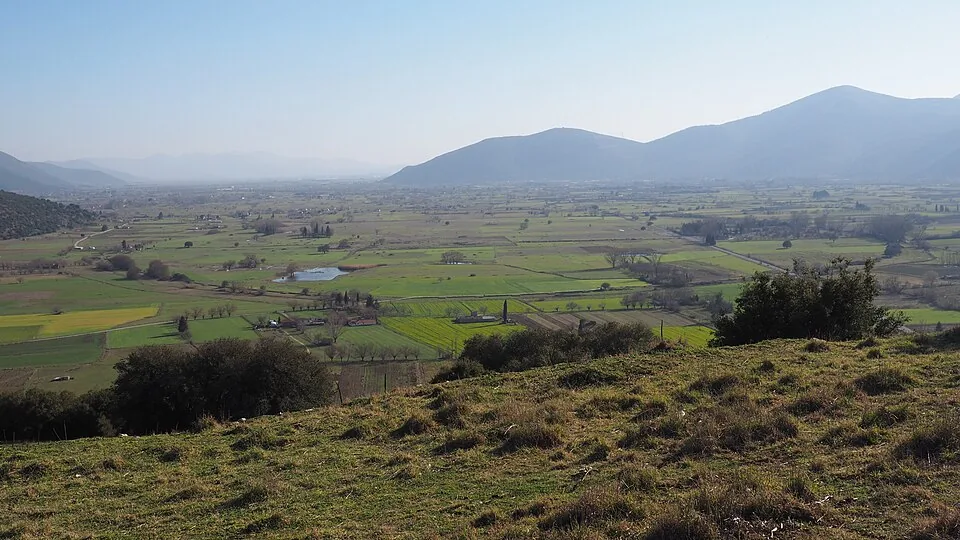
The opposing army contained Argives, Mantineans, Athenians, and other partners. Sparta fought with its own allies, including Tegea, whose rivalry with Mantinea gave the campaign a strong local dimension. The battlefield should therefore be understood as a meeting of coalitions with overlapping interests. Athenian participation mattered, but describing the encounter simply as another duel between Athens and Sparta erases the Arcadian and Argive stakes.
Thucydides offers an unusually detailed account of the Spartan order of battle and its subordinate commands. He also acknowledges the difficulty of establishing exact numbers. The force included units with different identities and experiences, among them troops associated with Brasidas' earlier campaigns. This diversity complicates the idea of a completely uniform citizen army. Its effectiveness depended on coordination among divisions and on the behavior of allied contingents as well as on Spartan drill.[1]
Orders that did not work as intended
As the armies advanced, their lines tended to drift to the right, a movement Thucydides explains through each soldier's wish to gain protection from the shield of the man beside him. Agis saw a danger that his left would be outflanked and ordered a redistribution of units. Some troops were to move outward, while others shifted from the right to fill the resulting gap. This was an ambitious adjustment close to contact with the enemy.
The orders were not carried out as intended. Two officers failed to make the movement assigned to them, leaving a weakness that the opposing right exploited. Yet the Spartan center and right gained success against the forces in front of them. The battle's outcome therefore cannot be reduced to flawless execution of the king's plan. Local reverses and victories occurred within the same engagement, and the stronger parts of the Spartan line eventually made recovery possible.[1]
Victory and the use of a battle narrative
Sparta won and reestablished its position in the Peloponnese. Thucydides explicitly connects the result with the restoration of a reputation damaged by earlier setbacks, including Sphacteria. Political arrangements at Argos and among other allies changed afterward, though no single battle permanently eliminated local opposition. Victory strengthened Spartan leadership by demonstrating that its army could still defeat a substantial coalition in a major land engagement.
The account is also valuable for studying how hoplite warfare actually functioned. It shows officers, spacing, movement, fear, and contingencies that disappear in idealized images of an unbroken wall of shields. This battle must be distinguished from the second famous battle at Mantinea in 362 BCE, described by Xenophon and associated with the death of Epaminondas. The shared place name can conceal very different historical settings. The encounter of 418 belongs to Sparta's recovery within the Peloponnesian War, not to the later struggle after Leuctra.[1][2]
FOLLOW THE EVIDENCE
References & further reading
- Ancient textThucydides, History of the Peloponnesian War ↗
Richard Crawley translation, public domain. A contemporary source for the late fifth-century BCE conflict, with retrospective accounts of earlier events.
- Ancient textXenophon, Hellenica ↗
H. G. Dakyns translation, public domain. Covers the later Peloponnesian War and Greek affairs down to 362 BCE.
- Modern scholarshipThe Campaign and Battle of Mantineia in 418 B.C. ↗
Scholarly analysis of Thucydides' military narrative and its reconstruction; linked publication extract.