On this page
A hill with several pasts
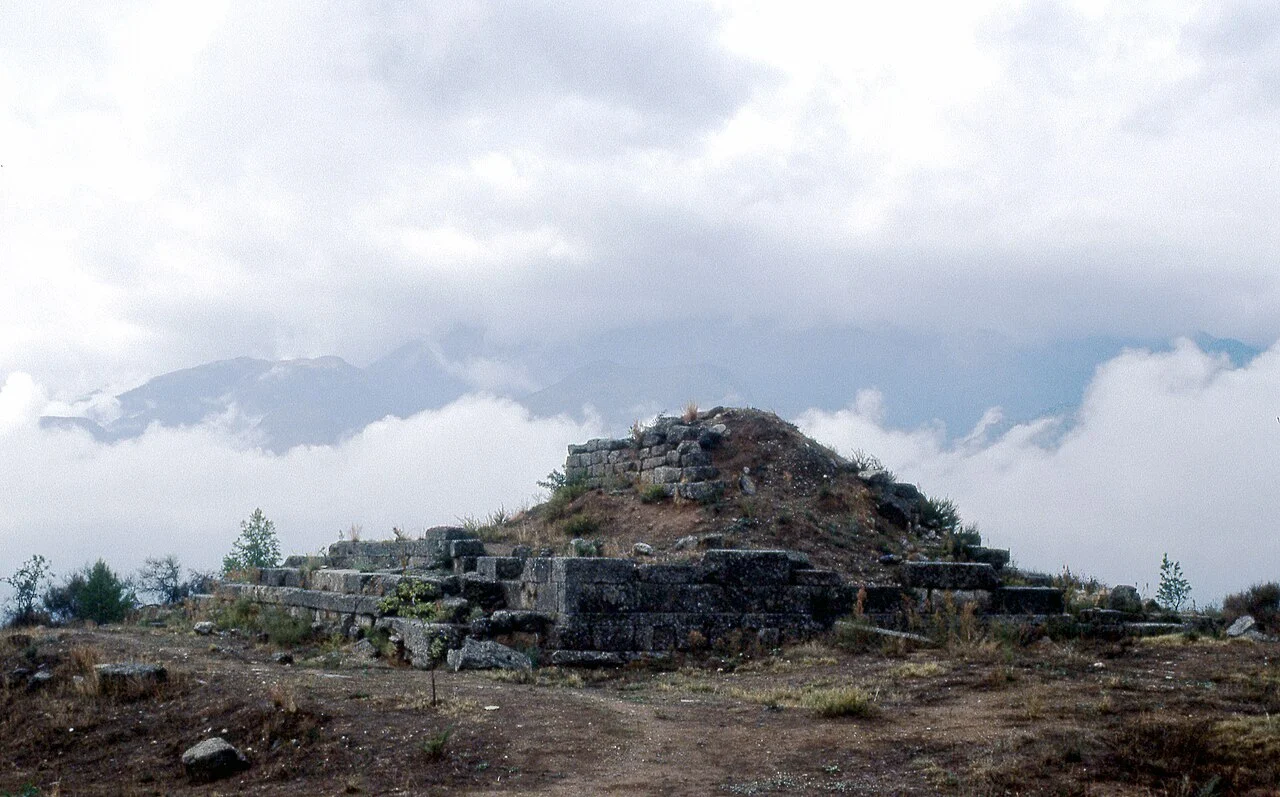
The Menelaion stands at Therapne, on the eastern side of the Eurotas, southeast of ancient Sparta. Looking toward the valley and Taygetus helps explain its striking setting, although a commanding view cannot by itself explain why worship began there. The British School at Athens excavations of 1909 identified a sanctuary structure rebuilt in the fifth century BCE and material reaching back into the seventh century BCE.
The same investigation encountered scattered Mycenaean material, while work nearby revealed a Bronze Age building later known as Dawkins’ House. These discoveries belong to different episodes in the hill’s history. A visitor should not combine them into one surviving palace of Menelaus. Early excavators themselves debated the sanctuary’s architectural interpretation. The evidence supports a landscape with successive uses; continuous occupation or an unbroken memory of a particular royal household requires a separate argument.[1]
The nurse who asked Helen for help
Herodotus tells a memorable story about the mother of the Spartan king Demaratus. As a child in a wealthy household, she was considered unattractive. Her nurse repeatedly carried her to Helen’s sanctuary at Therapne and prayed for a change. One day, according to the account, a woman appeared, asked to see the child, touched her head, and promised that she would become the most beautiful woman in Sparta.
This is a reported miracle, not a medical observation or an event that archaeology can verify. It nevertheless shows the kind of power an ancient storyteller associated with Helen. Herodotus places the episode within a complicated account of marriage and Demaratus’s contested parentage. Beauty has consequences for a royal genealogy. The nurse acts decisively, but the passage does not identify her legal status: calling her a helot would add information the source does not supply.[2]
Goddess, heroine, and persuasive praise
Helen’s place in Spartan religion cannot be read directly from her role in the Trojan War stories. Lowell Edmunds examines the fourth-century BCE writer Isocrates, whose praise of Helen includes the claim that Spartans offered ancestral sacrifices to Helen and Menelaus as gods. The statement is valuable, but its purpose matters. An encomium aims to praise its subject, and religious claims can help that argument.
Edmunds emphasizes the difficulty of making Isocrates into a straightforward guide to local ritual. The categories “hero” and “god” should not be treated as labels with identical meanings in every surviving account. Nor does honoring Helen establish that all Spartan women enjoyed the status imagined for a divine figure. A sacred story and a social description answer different questions. Reading the speech alongside other testimony makes the uncertainty visible instead of resolving it through a convenient modern label.[3]
A tomb in one tradition, a different ending elsewhere
Writing in the second century CE, Pausanias describes a sanctuary of Menelaus at Therapne and reports a local claim that Menelaus and Helen were buried there. His wording preserves what people said about the place. It does not identify excavated human remains or demonstrate that the characters of epic can be located in a historical grave.
Pausanias then records a conflicting Rhodian account of Helen’s death. That juxtaposition matters: even an ancient visitor could encounter competing local claims rather than a single agreed biography. A place associated with a famous figure might express a community’s relationship to the past without supplying the evidence a modern historian would need to authenticate that figure’s life. The disagreement belongs in the story of the sanctuary, because the variety of traditions is itself part of the historical record.[4]
What the sanctuary lets us see
The most revealing approach is to keep the worshippers in view. A nurse’s prayer, a royal family’s ancestry, and a traveler’s account of local burial traditions each show a different use of Helen’s reputation. They do not give equal access to every resident of Laconia. The wealthy child in Herodotus cannot stand for citizen women in general, still less for enslaved women whose own accounts are absent here.
The Menelaion therefore invites two kinds of attention: to the surviving place and to the claims made about it. Treating a tradition as a tradition does not make it worthless. It changes the question from whether a miracle happened to why that particular miracle, at that particular sanctuary, seemed worth remembering.[2][4]
FOLLOW THE EVIDENCE
References & further reading
- ArchaeologyDeborah Harlan, Sparta Begins: BSA excavations, 1906–1910 ↗
British School at Athens, 2022; Menelaion investigation and nearby Bronze Age remains.
- Ancient textHerodotus, Histories 6.61–64 ↗
A. D. Godley translation; the nurse, Helen’s shrine, and Demaratus’s family.
- Modern scholarshipLowell Edmunds, Isocrates’ Encomium of Helen and the Cult at Therapnē ↗
Electronic Antiquity 14.2 (2011); rhetoric and the interpretation of cult.
- Ancient textPausanias, Description of Greece 3.19.9–10 ↗
W. H. S. Jones and H. A. Ormerod translation; Spartan and Rhodian traditions.