On this page
A war shaped by reform and alliance
Cleomenes III had combined social and constitutional reforms at Sparta with a campaign for greater influence in the Peloponnese. His successes threatened the Achaean League and led Aratus to seek help from Antigonus Doson of Macedon. The resulting coalition altered the balance of resources. Cleomenes could win engagements and exploit local opportunities, but he faced an opponent able to assemble a larger and more varied army.
By 222 BCE the struggle had reached the approaches to Laconia. Cleomenes needed to prevent the invading coalition from reaching Sparta, while shortages and the uncertainty of outside financial support constrained his options. The reforms that had expanded the citizen body were thus tested within a demanding Hellenistic war. This was not the army or political setting of Leonidas' century: mercenaries, cavalry, new equipment, and the rivalries of larger kingdoms all shaped the campaign.
The campaign connected local rivalries with the ambitions of neighboring kingdoms.[2][1]
A defensive position on two hills
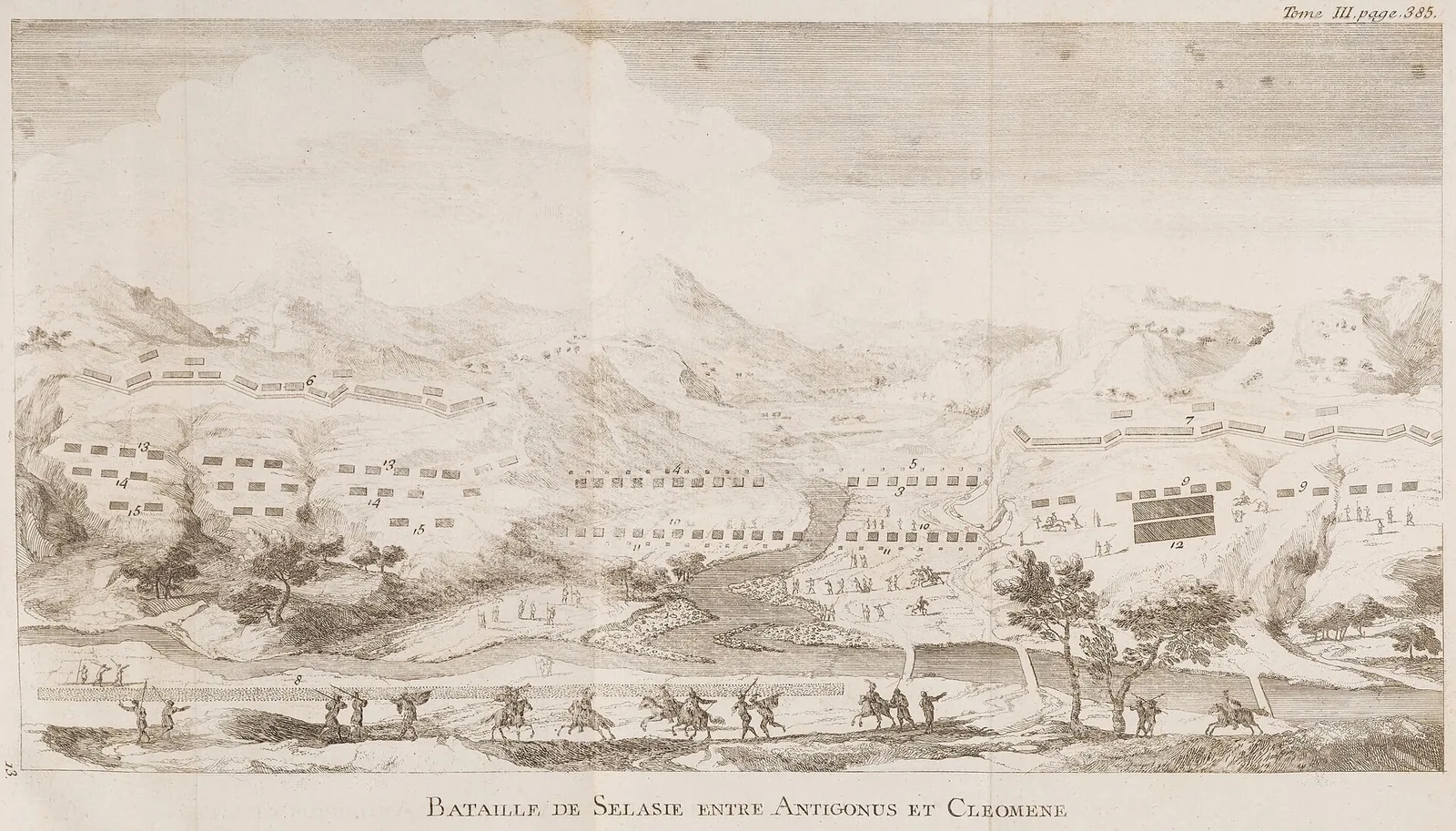
Cleomenes occupied a position near Sellasia, on a northern route toward Sparta. Polybius describes two hills, Evas and Olympus, with a valley between them. Eucleidas, Cleomenes' brother and colleague in the kingship, held one part of the position, while Cleomenes commanded the other. Cavalry and additional troops occupied the intervening ground. Fortifications and the terrain were intended to make the defenders difficult to dislodge.
Antigonus examined the position before committing to the attack. His force included Macedonians, Achaeans, and other allies, along with troops serving different tactical roles. Polybius supplies detailed figures and deployments, but reconstructing every movement on the modern landscape remains difficult. The encyclopedia's marker identifies the Sellasia area rather than claiming a precisely established location for each ancient formation. Geography clarifies the defensive problem without replacing the need to evaluate the written evidence.[1]
The collapse of the defensive line
The coalition attacked across the different parts of the battlefield. Fighting on the hill held by Eucleidas became especially important when the defenders were driven from their position and the king's brother was killed. Polybius also highlights the initiative of the young Achaean cavalryman Philopoemen, who recognized a danger and acted before the expected command. His account gives individual judgment a role within a battle otherwise organized through carefully described formations.
Cleomenes' troops were eventually overwhelmed, and he escaped toward Sparta. Ancient casualty figures emphasize the scale of the defeat, but they should be treated as claims within the narratives rather than exact modern totals. The essential outcome is clear: the force defending the approach had been broken, and the city could no longer be protected by the army Cleomenes had assembled. The defeat joined a battlefield reversal to the collapse of his wider political project.[1][2]
Occupation and competing historical judgments
Cleomenes left Sparta and eventually reached Egypt. Antigonus entered the city and altered its political arrangements, presenting his actions as a restoration of the ancestral constitution. That language mirrored the claims Cleomenes himself had used to justify reform. The precise fate of each social measure is debated; the removal of the king and reversal of his concentration of power do not prove that every landholding or personal status changed back immediately.
Polybius and Plutarch approach the conflict from different perspectives. Polybius is closely concerned with Achaean affairs and criticizes Phylarchus, a historian sympathetic to Cleomenes, for emotional and selective narration. Plutarch preserves a more admiring portrait of the Spartan king. Comparing them exposes how judgments about tyranny, reform, courage, and suffering shape the telling of military events. Sellasia ended Cleomenes' rule, but Sparta continued through further upheavals and into Roman history. The battle marks a major failed renewal, not the disappearance of the community.[1][2][3]
FOLLOW THE EVIDENCE
References & further reading
- Ancient textPolybius, Histories, Book 2 ↗
W. R. Paton translation, public domain. Sections 65–70 describe Sellasia; the surrounding narrative also criticizes the historian Phylarchus.
- Ancient textPlutarch, Life of Cleomenes ↗
Bernadotte Perrin translation, public domain. A sympathetic later biography; compare its account of the war with Polybius.
- Modern scholarshipThe Spartan Polity after the Defeat of Cleomenes III ↗
Scholarly discussion of the reforms and their subsequent fate; the linked publication extract frames the constitutional problem.