On this page
After regional supremacy
The loss of Messenia and the weakening of Spartan hegemony did not end the city's history. In the Hellenistic period, Sparta faced a world shaped by Macedonian power, regional leagues, and competing monarchies. Its rulers and citizens still possessed a formidable historical reputation, but reputation could not by itself restore lost resources. Questions about land, debts, citizenship, and military manpower became central to attempts at recovery.
Agis IV and Cleomenes III pursued reforms that were presented as a return to ancestral arrangements. Their programs encountered different political circumstances and used different methods. The language of Lycurgan restoration made innovation intelligible within a society that valued antiquity. It should not lead modern readers to assume that reformers were simply reinstating a fully documented ancient constitution. The past was an argument within contemporary political struggles.[1]
War and new relationships
Cleomenes' expansion brought him into conflict with the Achaean League and its Macedonian support. His defeat at Sellasia in 222 BCE transformed the city's position. Subsequent rulers, including Nabis, pursued their own combinations of military action and social change. The surviving literary portraits often come from hostile traditions, especially those sympathetic to Sparta's opponents. Descriptions of tyranny therefore require attention both to reported actions and to the political vocabulary of the authors.
Sparta's incorporation into wider systems of power involved conflict, negotiation, and changes to its institutions. The Achaean League and then Roman intervention altered the conditions under which local autonomy could operate. It is misleading to imagine a single moment when everything Spartan disappeared. Institutions could be suppressed, restored, renamed, or adapted, and their significance could change even when familiar titles survived. The city's later history is a sequence of such adjustments.[1]
Living with a famous past
Under Roman rule, Sparta's ancient reputation became a resource. Visitors could encounter a place associated with discipline, courage, and distinctive customs. Local elites had reasons to support monuments and performances that emphasized continuity with that past. The result was not merely a museum created by outsiders. Inhabitants actively participated in presenting their community and negotiating the advantages of cultural prestige within the Roman world.
Pausanias' second-century CE description is a major witness to this landscape of memory. He records sanctuaries, tombs, statues, and stories about rulers and heroes. His account shows what could be seen or heard in his own time, while also preserving traditions about earlier centuries. The two layers must be distinguished. A Roman-era claim about an ancient practice is evidence for later remembrance even when it cannot independently prove the practice's Classical form.[2][1]
Buildings, performance, and continuity
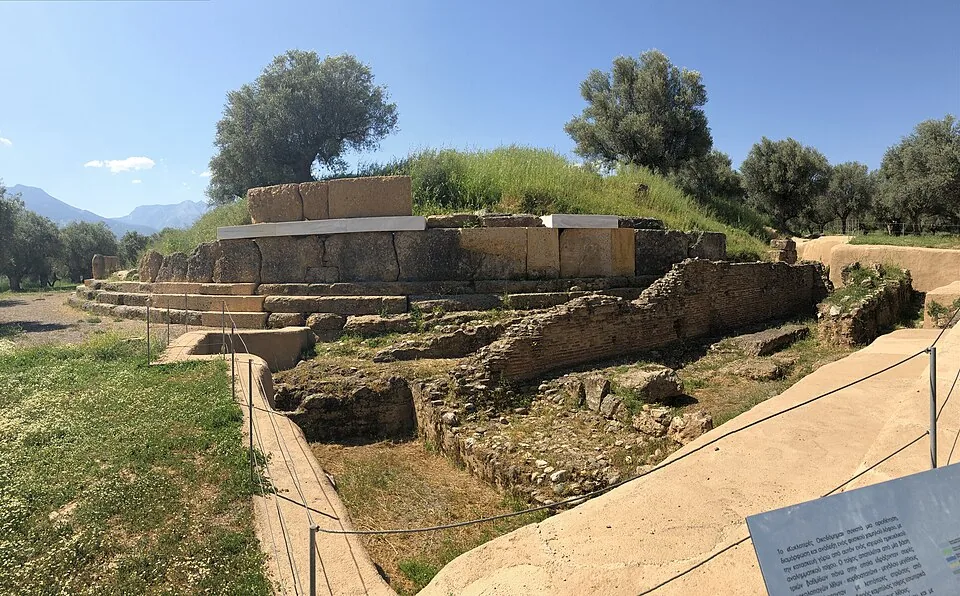
The ancient theatre is one of the most visible remains at Sparta today. Its monumental form and subsequent alterations belong to a later history than the Persian Wars. Other remains and reused architectural elements likewise show construction, repair, and changing occupation. A visitor standing among these ruins is encountering a city with a long sequence of lives, not the intact physical setting of Leonidas' childhood.
Religious activity, civic honors, and public spectacle continued to give the city social structure. At the same time, later transformations, including Christianization and changes in settlement, altered how older sacred places were used. Archaeology helps recover this complexity where a narrative ending at Leuctra or Sellasia would overlook it. Hellenistic and Roman Sparta deserves attention because it demonstrates that a community can remain historically active after losing political supremacy. Its inhabitants inherited powerful stories, but they also made choices and built institutions in the circumstances of their own age.
Pausanias' itinerary moves among monuments associated with kings, athletes, poets, and gods. That range shows how Roman-era visitors encountered several different versions of Spartan distinction in the same city.[3][2]
FOLLOW THE EVIDENCE
References & further reading
- Ancient textPausanias, Description of Greece, Book 3.1–13 ↗
Royal traditions and the description of Sparta. A Roman-era account, not a contemporary record of the Archaic period.
- Ancient textPausanias, Description of Greece, Book 3 ↗
The second-century CE travel account of Laconia. Its monuments and local traditions belong to the author's time and require comparison with earlier evidence.
- ArchaeologyBritish School at Athens: Return to Sparta ↗
Archive account of the 1924–1927 excavations, including the theatre and evidence for later phases of the city.