On this page
A foundation date and an inhabited coast
The National Archaeological Museum of Taranto presents 706 BCE as the traditional foundation date of Taras, the Spartan colony in Magna Graecia, or Greek southern Italy. “Traditional” is essential: an exact year transmitted through ancient chronology is not the same thing as a dated foundation document. Archaeology places an interruption in the indigenous settlement of the Old City around the end of the eighth century BCE, broadly consistent with the remembered period.
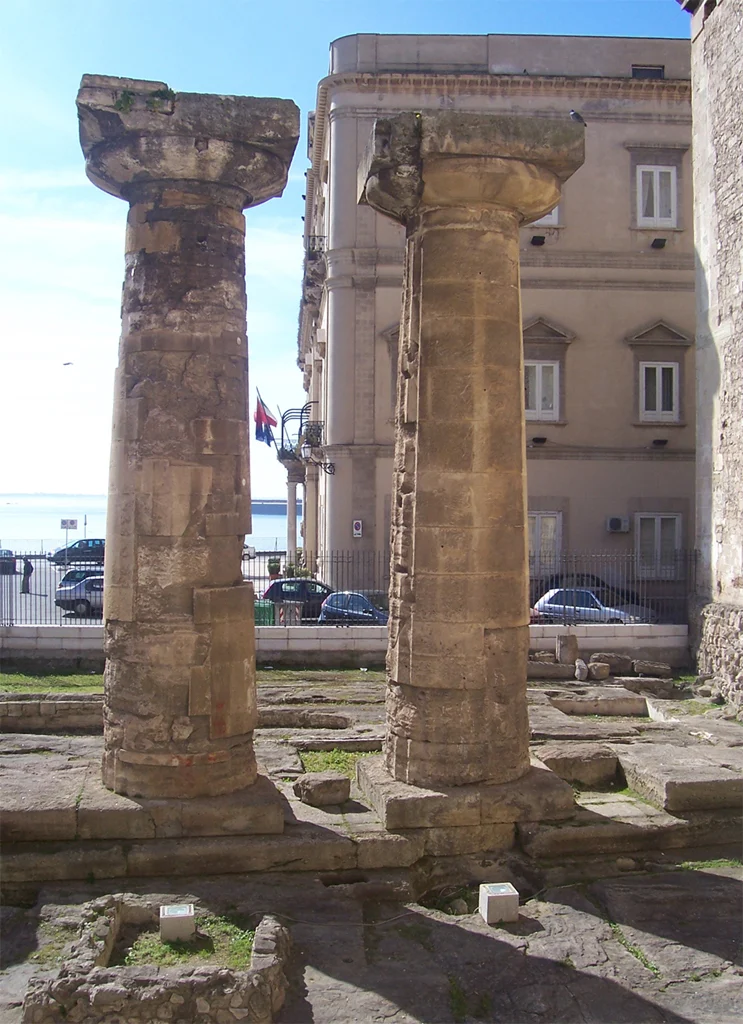
The coast was already inhabited. The museum’s account also recognizes evidence of interaction and coexistence, so a simple picture of Greeks arriving in an empty landscape is misleading. The surviving Doric columns in Piazza Castello belong to a later chapter, an early sixth-century BCE temple. They are evidence of the Greek city’s subsequent development, rather than surviving architecture from the moment its settlers supposedly landed.[1]
Who were the Partheniai?
Strabo preserves competing explanations of the settlers’ origins. In the version he attributes to Antiochus, exclusion from citizenship is connected with wartime circumstances in Sparta, and a group called the Partheniai becomes politically dangerous. Phalanthus emerges as their leader. A planned rising associated with the Hyakinthia fails, and the story eventually leads through consultation at Delphi to settlement at Taras.
The account attributed to Ephorus explains the crisis differently. It connects the Partheniai’s birth to the long absence of Spartan men fighting in Messenia and to arrangements made to produce another generation. The details of parentage and civic exclusion do not simply match Antiochus’s version. They should not be combined into a confident genealogy of every colonist. These are later explanations of an early community, not passenger lists or contemporary citizenship records.[2]
Founding stories and the politics of belonging
Aristotle also invokes the Partheniai when discussing political conflict. For him, they illustrate the resentment of people who believed their descent entitled them to a position that the established community denied them. His interest is analytical: the example helps explain why an aristocratic constitution might encounter opposition. It is not a full narrative of the voyage to Italy.
Read together, these accounts make contested belonging central to the foundation tradition. They do not license the claim that the settlers were simply “helot children,” or that all their mothers shared one known legal position. Women appear within explanations constructed around male descent, military absence, and political admission; their own testimony is not preserved. The narratives tell us what later writers thought could explain a rupture within Sparta. Their disagreements also limit what can be reconstructed about the individuals who migrated.[3][2]
How a Spartan colony became democratic
The later political history is another reason to avoid imagining Taras as a permanent overseas district of Sparta. In the Politics, Aristotle associates its movement toward democracy with a defeat by the Iapygians in which many leading men died. His example concerns how a change in the balance between social groups could alter a constitution. He also discusses Tarentine arrangements involving both election and selection by lot, and measures intended to ease the condition of poorer people.
Modern interpretation complicates a dramatic “one battle created democracy” summary. Maurizio Giangiulio argues that Aristotle’s account should be understood in terms of a gradual social process, rather than an immediate constitutional switch on a securely recoverable day. This is an interpretation of compressed testimony, not a newly discovered decree. The safe conclusion is that Taras had its own political development; its Spartan ancestry did not freeze its institutions.[3][4]
Remembering origins without repeating them
Strabo’s description of Taras emphasizes its harbor and later power. Those features belong to the city he describes across a long historical account, and should not all be projected backward onto the settlement of 706 BCE. Foundation, growth, and later recollection are separate stages. Calling a place a colony identifies a claimed relationship of origin; it does not establish continuous political obedience to the founding city.
That distinction makes Taras especially useful for studying Sparta. A foundation story centered on exclusion could coexist with a later community known for different institutions. The contrast is not evidence that either place possessed a timeless national character. It shows why historians follow particular people, stories, and constitutional arrangements across periods. Taranto’s Spartan connection matters most when it opens those questions, rather than ending them with the assumption that everything abroad must have worked as it did in Laconia.[2][3]
FOLLOW THE EVIDENCE
References & further reading
- ArchaeologyMArTA, Taranto from its foundation to the Roman conquest ↗
National Archaeological Museum of Taranto; chronology, settlement, and temple remains.
- Ancient textStrabo, Geography 6.3.1–4 ↗
H. L. Jones translation; the different Antiochus and Ephorus foundation traditions.
- Ancient textAristotle, Politics 5.3, 5.7, and 6.5 ↗
William Ellis translation; 1303a, 1306b, and 1320b on Tarentine political change and institutions.
- Modern scholarshipM. Giangiulio, Taranto diventa democratica ↗
Atti e memorie della Società Magna Grecia 7 (2016), 19–31; consulted the institutional abstract on gradual political change.